Economic & Market Update: Q1 2026
The US economy grew at an annualized rate of 2% in the first quarter due to continued AI-related investments and resilient consumer spending, which increased due to demand for healthcare and financial services.1 Retail sales rose 1.7% in March,2 driven by higher energy prices from the heightened global shipping and oil supply fractures. Discretionary spending continues to be supported by higher-income households as the K-shaped economy continues and larger tax refunds due to the 2025 tax bill,3 although lower-income households are using their tax refunds to pay down debt. Consumer sentiment weakened amid the rising energy costs but has not translated to lower consumer spending yet.
This dynamic was reflected in the highly fractured equity market, where defensive sectors demonstrated stability against headwinds in technology and software. Looking ahead, volatility may rise as markets price in shifting sector leadership, potentially delayed monetary easing, and ongoing geopolitical uncertainty.
The war in Iran has brought constantly shifting cease fires, opaque negotiations on opening the Strait of Hormuz, and resulting unstable access to energy supply for much of the globe.[4] While the United States is not dependent on oil from the region, 25-30% of the global oil supply passes through the Strait supplying much of Asia and parts of Europe. This quickly impacted not just the price of oil, but many other products derived from oil. This includes fertilizers and plastics.
Impact Investing in a Changing Global Landscape
We see a direct correlation between current global events and our core priorities as impact investors. Our commitment to sustainable practices addresses the root vulnerabilities of our global systems in three critical ways:
- Supply Chain Resilience: Environmentally conscious clients have long prioritized reducing plastics, which are inextricably linked to fossil fuel production.
- Agricultural Independence: By supporting regenerative agriculture, we reduce the global reliance on synthetic fertilizers—a primary byproduct of fossil fuels.
- Energy Transition: Emphasizing fuel efficiency and the mainstream adoption of electric vehicles (EVs) directly diminishes our dependence on oil.
Market data suggests that consumers are already shifting their behavior; for instance, we are encouraged by the 51% spike in European EV sales this past March. 5
While we do not suggest that adopting impact-aligned practices would end all global conflict, we see an undeniable connection between the frequency and severity of modern wars and our collective reliance on fossil fuels. This first-quarter market and economic review aims to provide a deeper perspective on how we, as impact investors, can navigate and respond to these challenging times.
US Economic Review
US GDP grew 2.7% year-over-year in Q1, accelerating from Q4 2025, driven by increased investment in AI-related equipment and software. The economy is also supported by a stable labor market—unemployment rate was steady at 4.3% following a modest rebound in job creation in March. However, real wage growth was 0.3% as inflation offset salary gains, which will impact purchasing power as consumer prices increase.6
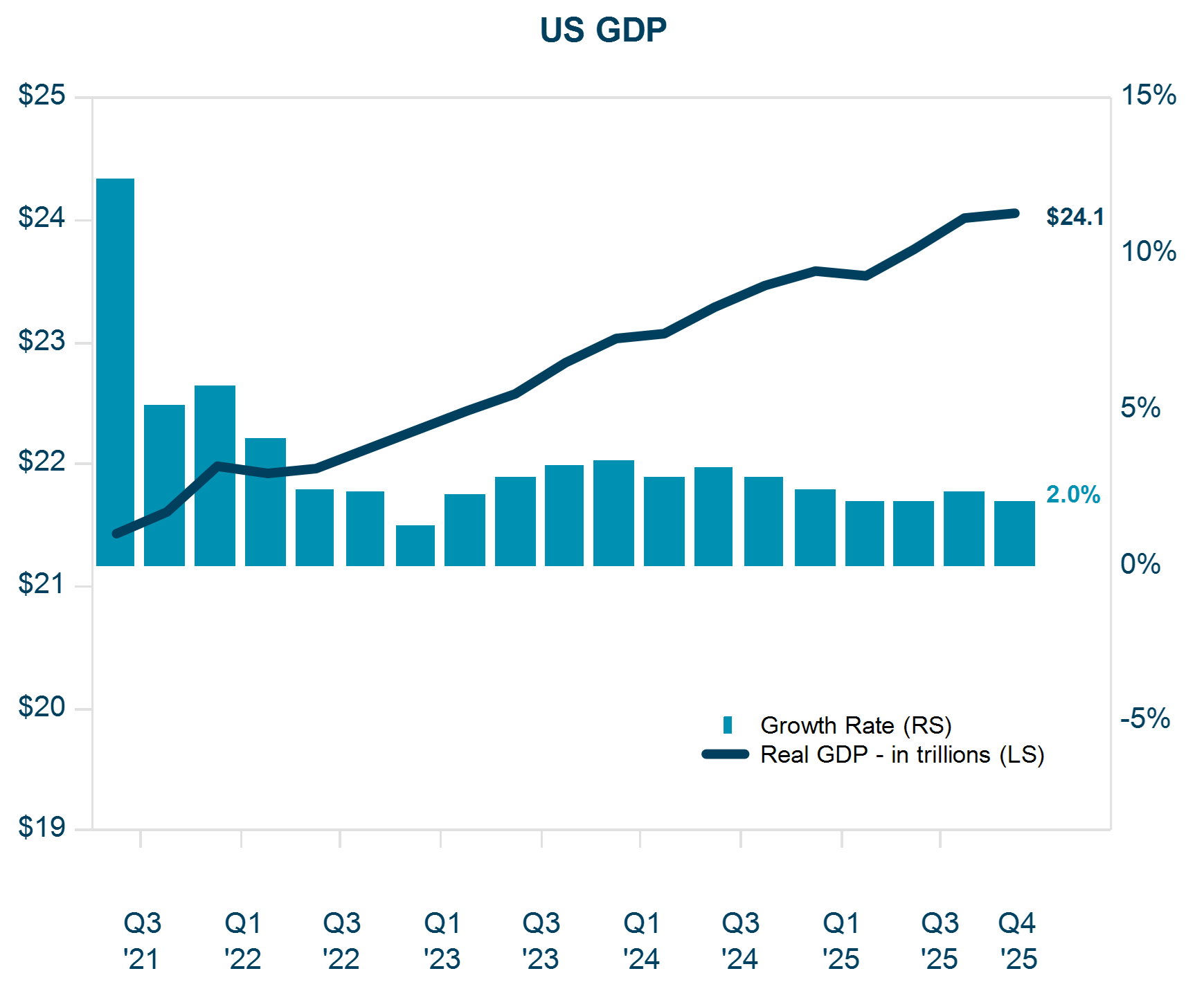
US GDP data from Q1 2021 to end of Q4 2025 7
The Labor Market: Stabilizing After Q4 Turbulence
After facing significant turbulence and a statistical contraction in late 2025 that was exacerbated by a government shutdown, the U.S. labor market found firmer footing in the first quarter of 2026 as job creation experienced a modest, steady rebound. The unemployment rate improved slightly, ticking down to 4.3% by the end of March 2026, recovering from its 4.4% level at year-end. Businesses remain heavily focused on retaining existing talent and maximizing productivity rather than aggressive headcount expansion.8 However, headline numbers might be masking longer duration of unemployment and lower labor force participation rates that are well below pre-pandemic norms, as discouraged workers stop looking for jobs.
Inflation and Monetary Policy
The first quarter saw a dramatic shift in inflation. The first two months of the year were characterized by stable year-over-year headline inflation at 2.4%, down from 2.7% at the end of Q4. However, by the end of March, headline CPI increased to 3.3% driven by an energy shock as a result of the closure of the Strait of Hormuz. Overall energy costs increased 10.9% in a single month and 12.5% year-over-year, which accounted for almost three-fourths of the entire March CPI increase. However, higher energy costs haven’t translated into higher core inflation yet, as it increased by a mild 0.2% month-over-month.
The Fed held rates steady at a range of 3.5% – 3.75% in March and April, signaling a cautious “wait and see” approach as they weighed signs of lower, but persistently elevated, inflation, a stable labor market, and solid growth against ongoing new geopolitical uncertainties.9 New pressures of possible war-related inflation have scaled back expectations for continued rate cuts by the Federal Reserve.10
The war has reinforced vulnerability from prolonged energy shocks in other regions like Europe and Asia, which are more dependent on oil and gas from the Middle East. The longer the Strait of Hormuz is closed, the more the inflationary impact is likely to be on the upside with a likely downside impact on growth.
Market Update
The first quarter was a highly volatile period for equity and bond markets. The VIX surged nearly 69%, its biggest quarterly jump since 2020. The narrative abruptly shifted from soft landing confidence to growing macroeconomic unease.
The quarter began with continued AI-driven momentum but shifted quickly in late February and March as the war in Iran began. The geopolitical shock combined with a significant rise in oil prices due to the closure of the Strait of Hormuz. The focus of the AI-driven boom also shifted in the first quarter to companies in software and IT services, financial services, and consumer discretionary sectors that could be negatively impacted by AI. After several years of stock returns concentrated in certain mega-cap companies, sectors like energy, healthcare, utilities, and consumer staples rallied. Value stocks, mid-cap, and small-cap performed well as rotation in the market took hold.
Stock Market Returns
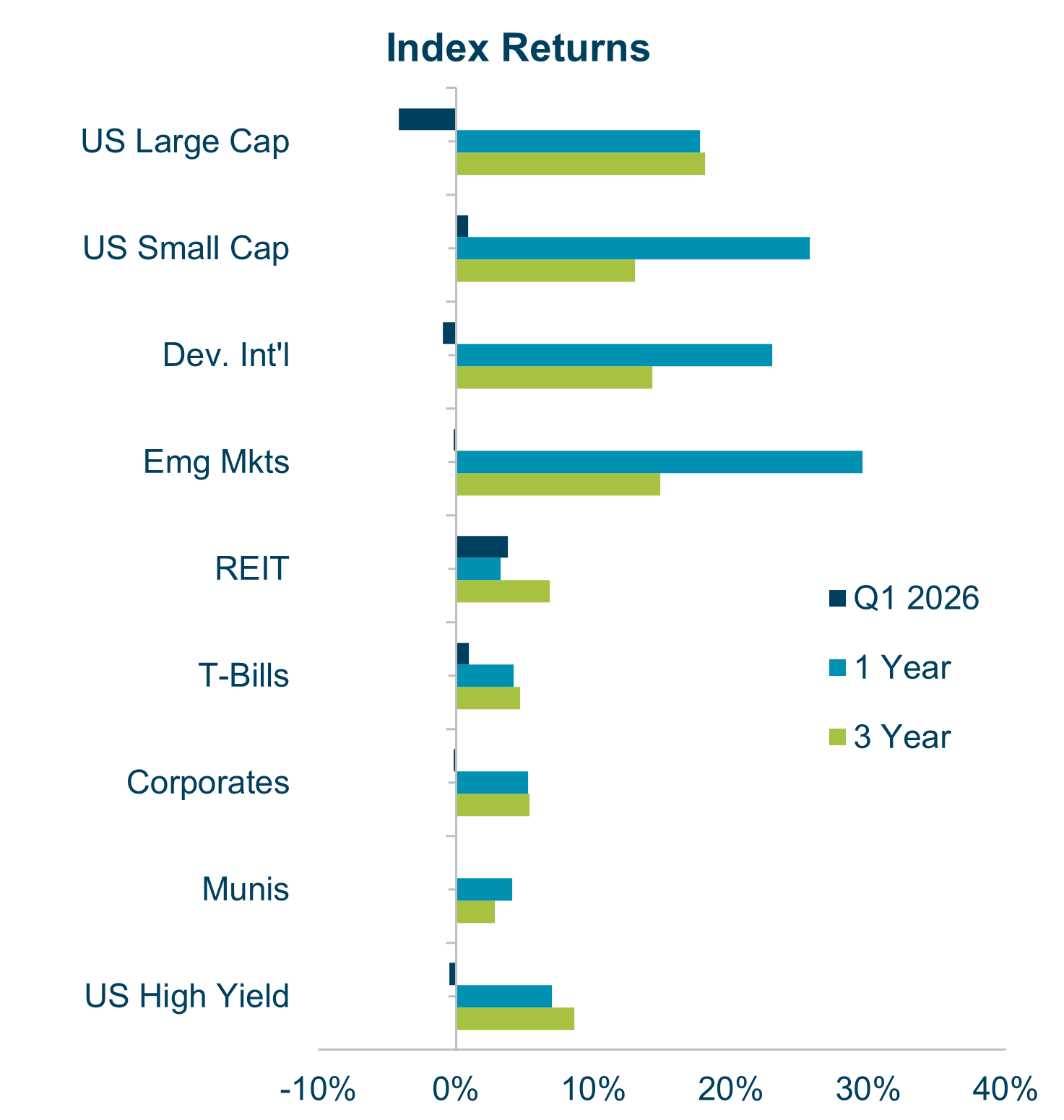
Caption: Q1 2026 Index Returns, Source: eVestment and FRED 11
The Russell 1000, a US large cap index, was down 4.18% in Q1 as investors reassessed the macroeconomic environment and the sell-off in mega cap and growth stocks deepened. For perspective, this index is still up over 17.7% for the 12 months ended March 31st, 2026. Microsoft, one of the Magnificent 7 companies, was down over 23% in Q1 due to concerns about the return on investment in AI buildouts.12
However, US small-caps with strong domestic earnings were less impacted by geopolitical events and showed resilience driving positive 0.9% return. US small-caps are also less exposed to technology and software companies.
International developed markets outpaced US markets in January and February, driven by a weaker dollar, but the war in Iran hit Europe harder due to its reliance on energy imports. Surging gas and oil markets derailed the momentum, and the index returned -0.94% in Q1 but was still up 22.99% over the prior 12 months.
Emerging markets held up better than international developed markets with returns of -0.2% in the quarter and markets like Taiwan and South Korea benefited from AI related semiconductor demand earlier in the quarter.
Sector Update12
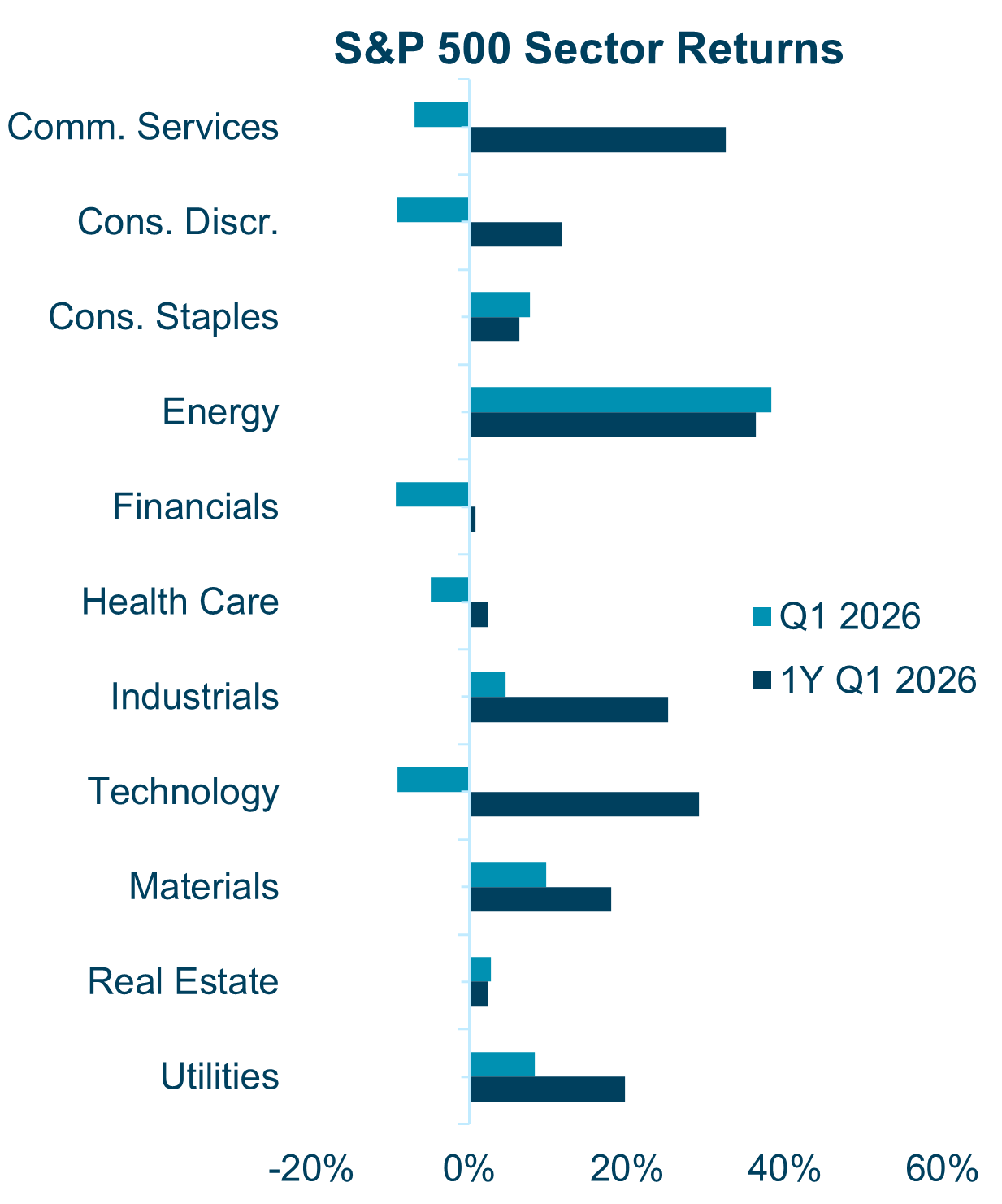
S&P 500 Sector Returns as of end of Q1 2026.
Sources: eVestment, S&P Global
The top three companies still make up nearly 20% of the market weight in the S&P 500. Despite the slump, the Technology sector still accounts for 32.9% of the S&P 500, compared to just 8.4% in the MSCI World ex-US index. Meanwhile, Financials make up 26.0% of the MSCI World ex-US (vs. 12.6% in the U.S.) and Industrials comprise 18.1% (vs. 9.0% in the U.S.).
Magnificent Seven | Earnings Hold Despite Pullback
The “Magnificent Seven” stocks have dramatically outperformed the broader S&P 500 since 2021, driving most of the index’s overall returns. This sustained price dominance is fundamentally anchored by consistently superior year-over-year earnings growth compared to the remaining 493 companies.
Mag 7 stocks amplified index gains in 2023 and 2024 and are now amplifying the drawdown in Q1 2026. Mag 7 stocks fell 11% in Q1 2026 while the S&P 493 declined just 1% and accounted for 83% of the S&P 500’s entire quarterly loss. Within the group, the divergence that began in 2025 has continued into Q1. Alphabet held up best, reflecting the market’s reward for demonstrated AI monetization. Microsoft has borne the steepest losses, down roughly 28% since November, despite no fundamental change to its enterprise franchise. Nvidia is down roughly 14% even as earnings estimates have continued to rise—a clear case of multiple compression rather than deteriorating fundamentals.
Despite higher volatility and the pullback in the first quarter, their growth advantage is projected to remain robust through 2026. The Mag 7 is still projected to grow earnings at +26% in 2026, roughly double the +14% forecast for the rest of the index.
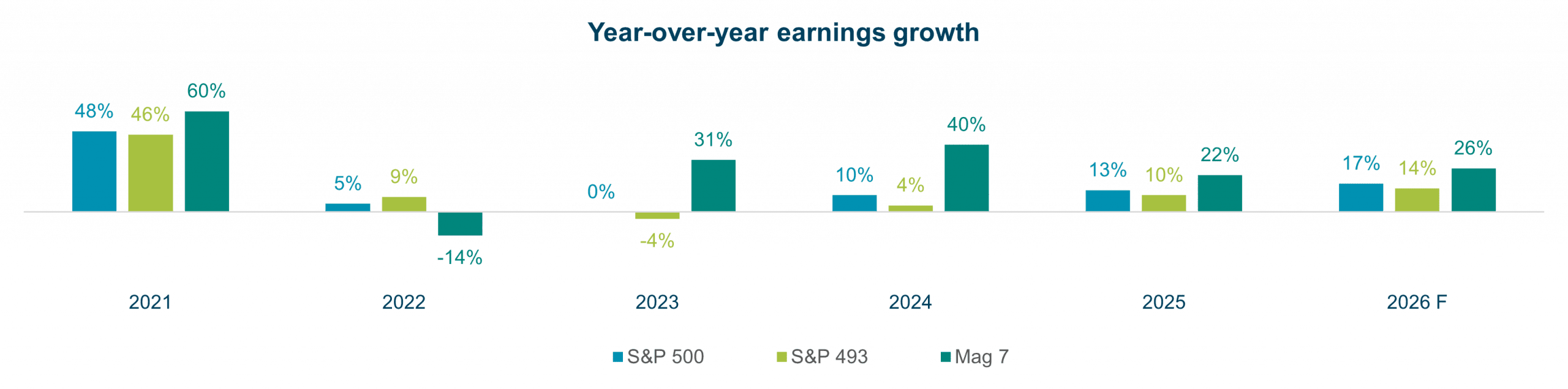
Source: J.P. Morgan Asset Management
Bond Market Summary
Similar to equity markets, bond markets were also volatile in Q1. The yield curve flattened significantly in Q1 2026 as the curve shifted higher across all maturities. Short-term rates surged the most from their end-of-2025 levels with the 2-Year rising from 3.47% to 3.79%. Long-term rates also drifted higher, with the 10-Year reaching 4.30% and the 30-Year anchoring at 4.88%.
Coming into 2026, the bond market had priced in multiple rate cuts. However, the surge in short-term yields reflects shifting Federal Reserve rate cut expectations due to resilient economic data and persistent inflation. The markets are also pricing in the impact of energy price shocks and AI-related corporate borrowing. Fed independence was also at the top of investors’ minds as they waited for Fed Chair Jerome Powell’s successor.
Short-term government bonds (T-bills) held up well in the quarter, gaining almost 1%, benefiting from the higher interest rate environment. Municipal and corporate bonds stayed relatively flat in the quarter as they were largely cushioned by high starting yields, as substantial coupon income offset losses from price declines as interest rates rose. Over the prior 12 months, Munis are up over 4% and corporates more than 5%. Investment-grade corporate credit spreads widened but also saw a historic surge in issuance. Hyperscalers accounted for 11% of all issuance in Q1 compared to a historical average of 1%; with continued issuance, we could see the composition of the bond index change with concentration in the technology sector similar to the stock market.
Staying Invested Through Uncertainty
Periods of market volatility driven by geopolitical shocks are often short-lived. Looking at nine major events since 1962, the S&P 500 delivered a positive one-year return in six of nine cases, with an average return of 4.8%. The impulse to exit markets during periods of fear has, in most cases, cost investors more than the events themselves. The cost of missing the recovery has typically exceeded the cost of enduring the volatility.
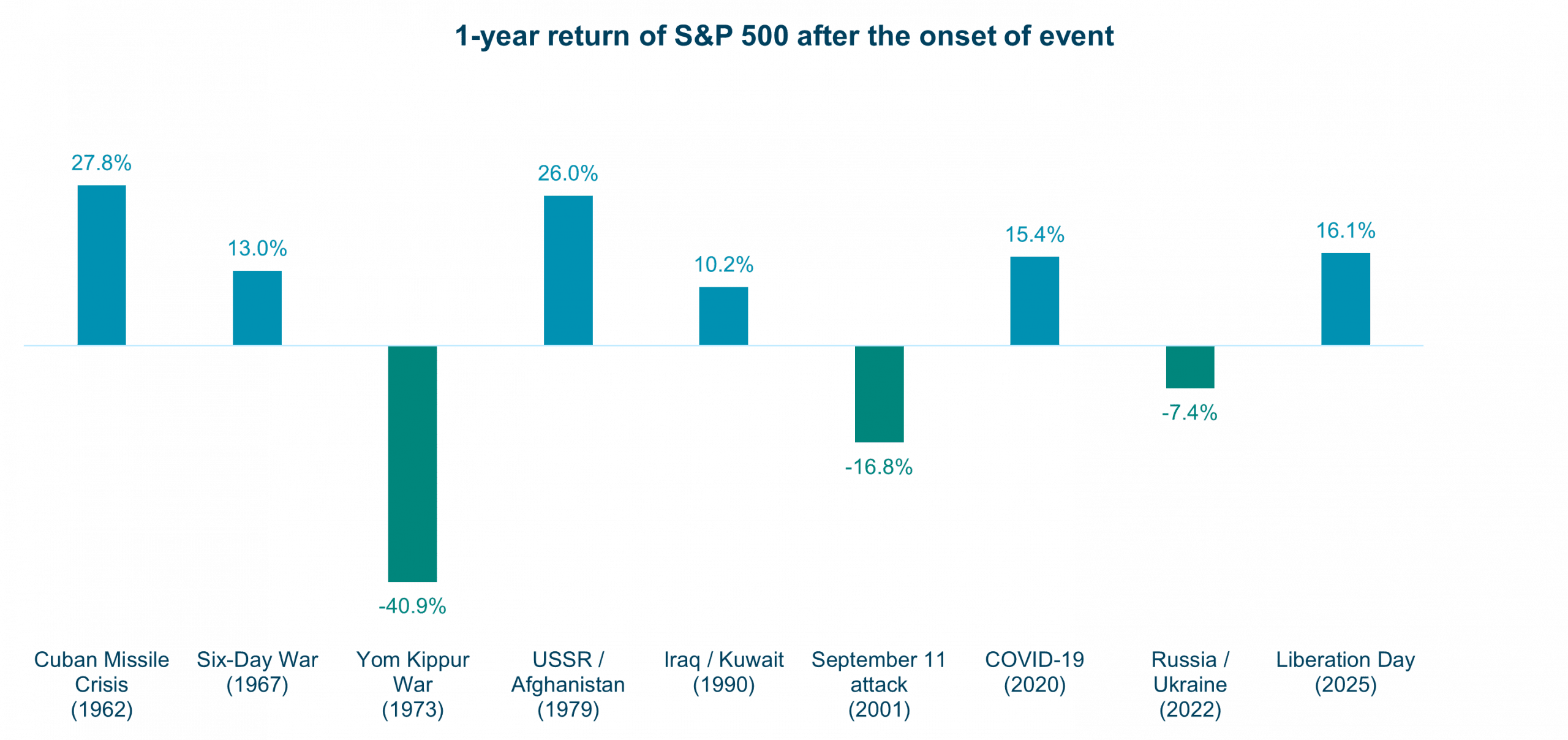
When we look historically at geopolitical events and their impact on markets, we recognize that these events don’t happen in a vacuum. Co-occurrences of additional economic or political forces can impair recoveries, as was the case in the Yom Kippur War of 1973. While the war itself lasted less than twenty days, the after-effect of the OPEC oil embargo created a structural, multi-year energy supply shock with lasting economic consequences.
The positive cases
The six positive events span Cold War tensions, regional conflicts, a global pandemic, and a trade policy shock. The consistency of positive one-year outcomes across six decades and such varied economic backdrops serve as a reminder that even major and catastrophic events can have short-lived market consequences. In most cases, investors maintaining long-term equity exposure through periods of elevated uncertainty have been rewarded.
Authors
Jane Swan is a Partner, Senior Advisor, and Chief Advisory Officer at Veris, and she holds the Chartered Financial Analyst (CFA®) designation. Bio.
Roraj Pradhananga is a Partner and Chief Investment Officer at Veris and a Certified Investment Management Analyst (CIMA®) and Certified Public Accountant (CPA). Bio.
Sources
2 https://www.bloomberg.com/news/articles/2026-04-21/us-retail-sales-surged-in-march-in-broad-advance
3 https://institute.bankofamerica.com/content/dam/economic-insights/consumer-checkpoint-april-2026.pdf
6 https://www.bls.gov/news.release/realer.nr0.htm
7 U.S. Bureau of Economic Analysis, FRED
8 U.S. Bureau of Economic Analysis, FRED
9 https://www.cnbc.com/2026/04/29/fed-interest-rate-decision-april-2026.html
11 Morningstar, FRED
13 Sources: Morningstar, S&P Global, MSCI
Disclaimer
The information contained herein is provided for informational purposes only and should not be construed as the provision of personalized investment advice, or an offer to sell or the solicitation of any offer to buy any securities. Rather, the contents including, without limitation, any forecasts and projections, simply reflect the opinions and views of the authors. All expressions of opinion reflect the judgment of the authors as of the date of publication and are subject to change without notice. There is no guarantee that the views and opinions expressed herein will come to pass. Additionally, this document contains information derived from third party sources. Although we believe these third–party sources to be reliable, we make no representations as to the accuracy or completeness of any information derived from such third-party sources and take no responsibility, therefore. Information related to the performance of certain benchmark indices is provided for illustrative purposes only as investors cannot invest directly in an index. Past performance is not indicative of or a guarantee of future results. Investing involves risk, including the potential loss of all amounts invested. The information contained in this document also includes certain forward-looking statements, often characterized by words such as “believes,” “anticipates,” “could,” “plans,” “expects,” “projects,” and other similar words that indicate future possibilities. Due to known and unknown risks, other uncertainties and factors, actual results may differ materially from the expectations portrayed in such forward-looking statements.