Economic & Market Update: Q4 2025
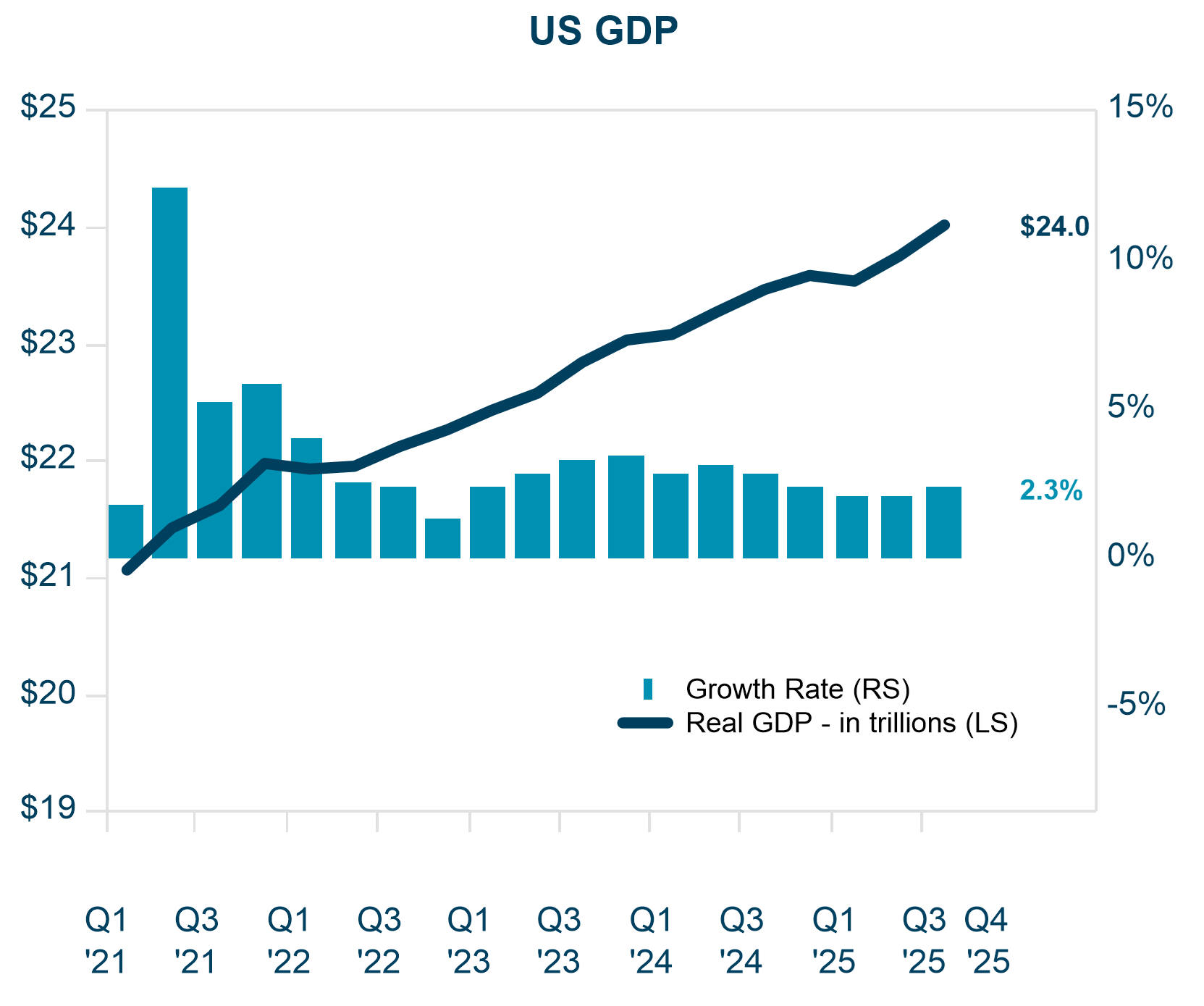
US GDP data from Q1 2021 to end of Q3 2025 7
In response to these mixed signals, the Federal Reserve has maintained a policy of gradual easing to support a soft landing. Looking ahead, we expect to see consumer sentiment deteriorate while businesses continue to make significant AI investments and other capital expenditures to take advantage of the 2025 tax bill provisions.
The Social Impact of the K-Shaped Economy
We continue to see signs of a “K-shaped” economy, where high-income households and tech-adjacent sectors thrive while lower-income groups face an intensifying squeeze. Three years of double digit stock market growth have dramatically increased wealth for stock market participants.8 With this expanding wealth, the top 10% of households are responsible for nearly 50% of consumer spending.9 Meanwhile, average credit scores for Americans have dropped, as low income earners face pressures of slow wage growth, high interest rates, and inflation with little to no benefit in their investment portfolios.10
Veris offered several examples of how a K-shaped economy can widen wealth gaps in our 2010 Community Wealth Building brief. In that report, we noted that the top 1% of Americans’ wealth increased from $5 trillion in 1989 to $40 trillion by the end of 2020. During that same time period the wealth of the bottom half of the population stagnated – increasing only from $1 trillion to $2 trillion.11 We also cited data in the report showing that, during the K-shaped recovery after the COVID-19 pandemic, historically under-resourced BIPOC communities faced disproportionately higher levels of poverty12 worse health outcomes13 and shorter life expectancy.14 In today’s K Shaped economy we believe these same communities are facing mounting challenges on a variety of fronts:
Limited access to opportunity: Wealth concentration limits access to quality education15 and business loans for under-resourced entrepreneurs,16 which in turn limits future earning potential for lower-income communities, reinforcing the “K.”
Unaffordable housing: Inflated home values mean that home-ownership is increasingly out of reach for low and middle income families,17 making it harder for those families to build generational wealth.
Limited access to affordable healthcare: Higher costs for healthcare and health insurance, combined with the loss of access to federal support through Medicaid disproportionately affect the lower leg of the “K”18
Market Update
Global equities capped a strong 2025 with positive Q4 gains, driving major indices to record highs. International and Emerging markets continued to outperform the US markets in Q4 resulting in significant outperformance for the full year for the first time in recent years. This was driven by AI-related technology companies in South Korea and Taiwan, attractive valuations in emerging markets, improving global growth, and the weakening dollar. US stocks reached record highs in Q4, but momentum cooled due to AI jitters.
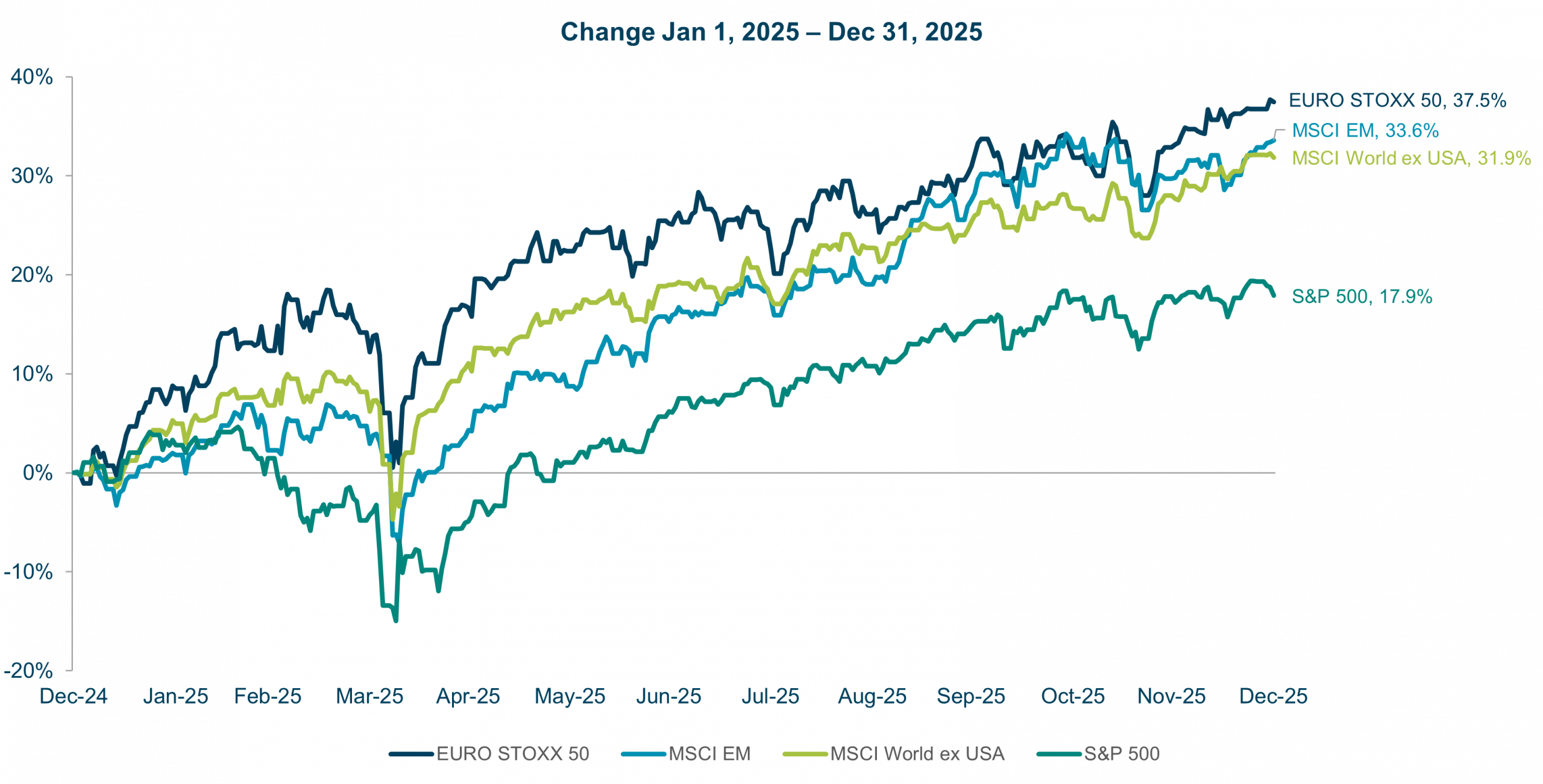
Chart comparing Euro Stoxx 50, MSCI EM, MSCI World ex USA, S&P 500 between 12/24 and 12/25.19
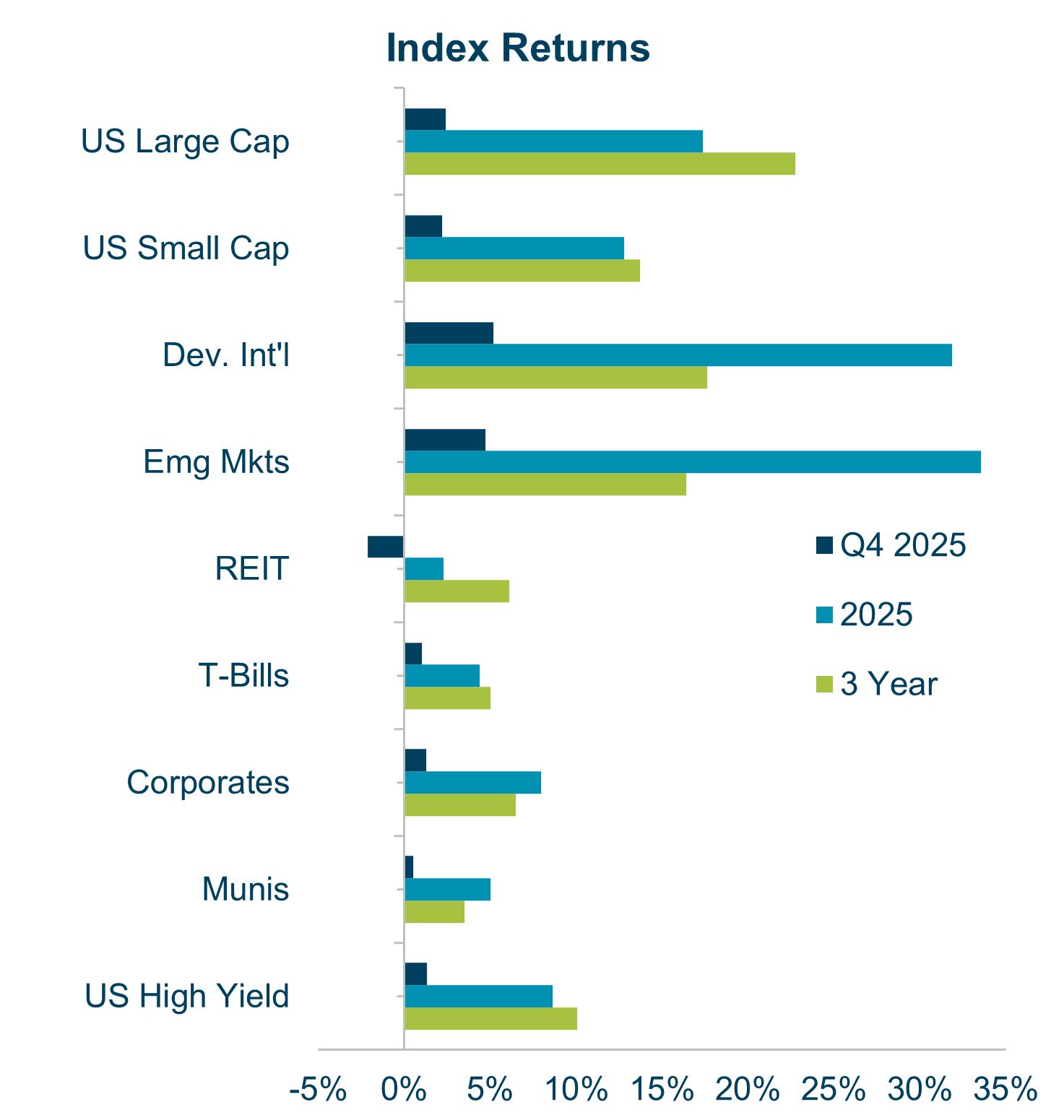
Q4 2025 Index Returns, Source: Morningstar and FRED20
Concerns about the return of AI investments and volatility of AI leaders like Nvidia resulted in sector rotation in Q4. Value stocks outperformed growth stocks as mega-cap tech rally stalled. Health Care rallied after a long period of relative underperformance driven by attractive valuations and a shift in investor sentiment from overcrowded Tech. However, Consumer Staples and Real Estate continued to lag. Utilities, with earlier strength fueled by the energy demands of AI pulled back in the quarter. The extreme concentration of the U.S. index has grown. The three largest companies now exceed 20% of the market weight. This remains a critical risk factor relative to the more balanced and diversified international indices.
Magnificent Seven | Sustained Market Leadership
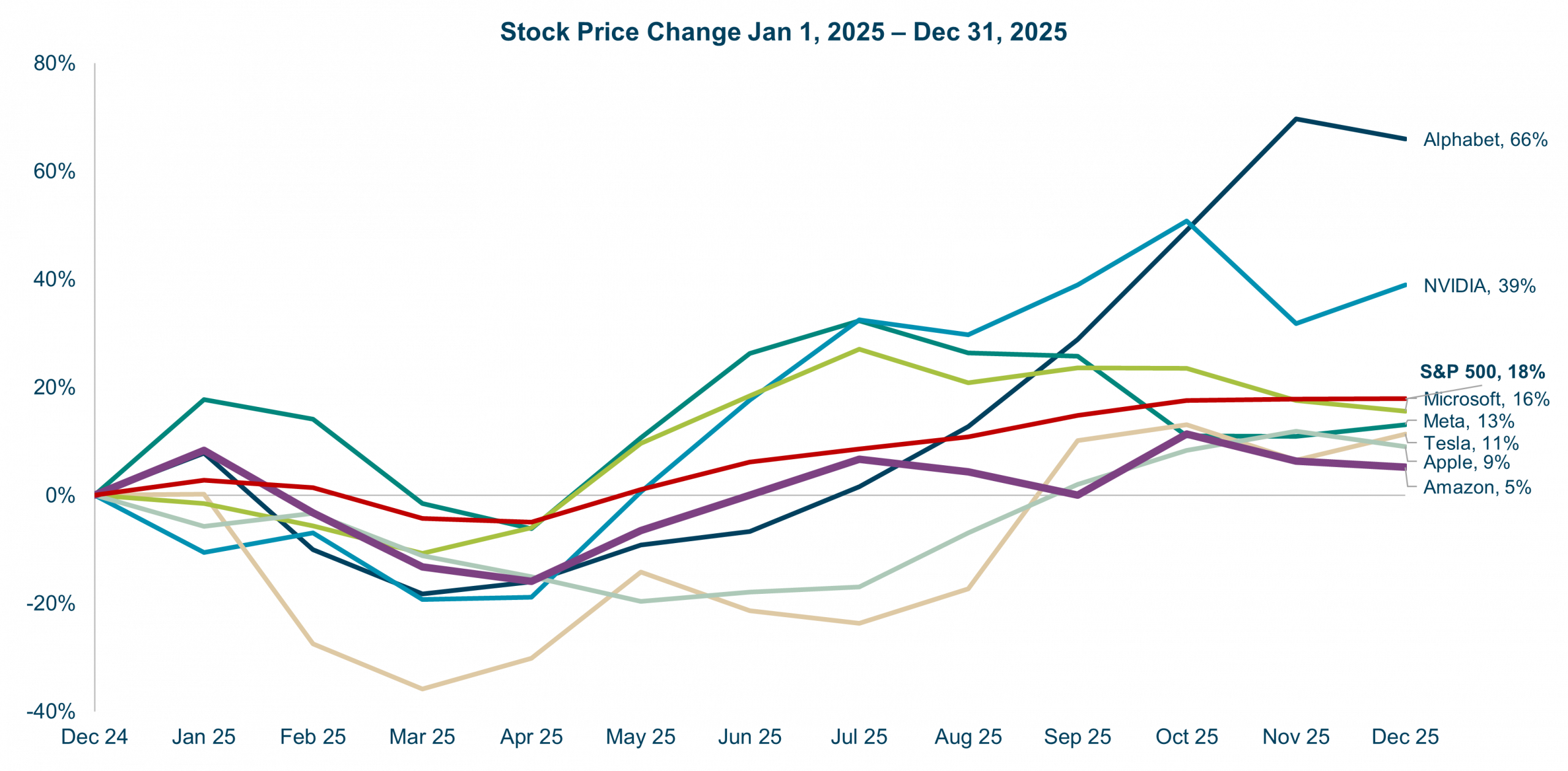
Chart: Stock Price Change comparing Alphabet, NVIDIA, S&P 500, Microsoft, Meta, Tesla, Apple, Amazon between Jan 1, 2025 and Dec 31, 2025 22
The “Magnificent Seven” continued their dominance in 2025, posting a collective return of 23% compared to 13% for the rest of the S&P 500. However, Q4 marked a decisive shift in leadership. Alphabet surged in the final quarter to become the year’s top performer (+66%), overtaking Nvidia (+39%), which cooled significantly in the second half. Unlike the uniform rallies of previous years, 2025 saw stark divergence. For the calendar year, only two of the Mag Seven outperformed the S&P 500 with the other 5 names trailing the index. Looking ahead, we believe volatility may rise due to unpredictable policy shifts, the continued normalization of market breadth, and the stamina of optimism over AI. Concentration risk in the US markets remains high. There is also reduced confidence in economic data from the Federal Government following the shutdown and continued delays in reporting.23
Our Work Continues
As we honor the retirement of Michael Lent, our final founding partner, we stand proud of the visionary foundation he and our other founders helped to build. For 18+ years, Veris has been a steadfast force in aligning wealth with purpose. Today, we believe our mission is more vital than ever. In a year defined by historic calls for equity and democracy, we do not just observe the moment. We, along with our clients, aim to meet it.
While federal support for climate and community resilience has been slashed, our resolve only strengthens. We are proud to assist our clients in transforming market gains into a powerful engine for progress, with the aim of ensuring that investments serve as a catalyst for a more just and sustainable future.
Authors
Jane Swan is a Partner, Senior Advisor, and Chief Advisory Officer at Veris, and she holds the Chartered Financial Analyst (CFA®) designation. Bio.
Roraj Pradhananga is a Partner and Chief Investment Officer at Veris and a Certified Investment Management Analyst (CIMA®) and Certified Public Accountant (CPA). Bio.
Sources
1. https://www.bls.gov/news.release/pdf/empsit.pdf
https://fred.stlouisfed.org/series/UNRATE
2. U.S. Bureau of Economic Analysis
3. https://www.wsj.com/tech/ai/how-the-u-s-economy-became-hooked-on-ai-spending-4b6bc7ff
4. https://www.bls.gov/news.release/pdf/empsit.pdf
5. https://www.reuters.com/world/us/us-economic-growth-slows-sharply-fourth-quarter-2026-02-20/
6. US businesses and consumers pay 90% of tariff costs, New York Fed says
7. U.S. Bureau of Economic Analysis, FRED
8. https://www.cnbc.com/2025/10/03/the-wealth-of-the-top-1percent-reaches-a-record-52-trillion.html
9. https://www.nytimes.com/2025/10/19/business/economic-divide-spending-inflation-jobs.html
10. https://www.cnn.com/2025/09/16/economy/debt-credit-score-student-loans
11. https://www.veriswp.com/wp-content/uploads/2021/09/Veris-_-Community-Wealth-Building-_-Sept-2021.pdf
12. https://www.kff.org/state-health-policy-data/state-indicator/poverty-rate-by-raceethnicity/
13. https://www.americanprogress.org/article/health-disparities-race-ethnicity/
14. https://apnews.com/article/science-health-coronavirus-pandemic-fac0863b8c252d21d6f6a22a2e3eab86
15. https://www.ihep.org/press/how-wealth-not-just-income-shapes-college-access-and-success/
16. https://carey.jhu.edu/articles/why-funding-costs-more-entrepreneurs-struggling-neighborhoods
17. https://nhc.org/can-you-hear-me-now-middle-class-americans-are-priced-out-of-housing/; https://www.nytimes.com/2026/02/23/business/home-buying-market-real-estate-economy.html
18. https://hsph.harvard.edu/news/how-medicaid-cuts-could-lead-to-loss-of-coverage-for-millions/
19. Morningstar
20. Morningstar, Fred
21. Morningstar, S&P Global, MSCI
22. Morningstar, J.P. Morgan Asset Management
23. https://www.ey.com/en_us/insights/strategy/macroeconomics/record-shutdown-leaves-mark-on-the-economy
Disclaimer
The information contained herein is provided for informational purposes only and should not be construed as the provision of personalized investment advice, or an offer to sell or the solicitation of any offer to buy any securities. Rather, the contents including, without limitation, any forecasts and projections, simply reflect the opinions and views of the authors. All expressions of opinion reflect the judgment of the authors as of the date of publication and are subject to change without notice. There is no guarantee that the views and opinions expressed herein will come to pass. Additionally, this document contains information derived from third party sources. Although we believe these third–party sources to be reliable, we make no representations as to the accuracy or completeness of any information derived from such third-party sources and take no responsibility, therefore. Information related to the performance of certain benchmark indices is provided for illustrative purposes only as investors cannot invest directly in an index. Past performance is not indicative of or a guarantee of future results. Investing involves risk, including the potential loss of all amounts invested. The information contained in this document also contains certain forward-looking statements, often characterized by words such as “believes,” “anticipates,” “could,” “plans,” “expects,” “projects,” and other similar words that indicate future possibilities. Due to known and unknown risks, other uncertainties and factors, actual results may differ materially from the expectations portrayed in such forward-looking statements.