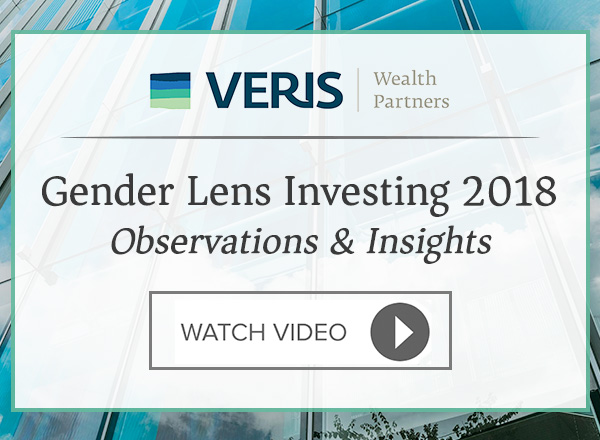
Veris Hosts Gender Lens Investing Webinar
Alison Pyott and Luisamaria Ruiz Carlile of Veris speak with Suzanne Biegel and Cynthia Nimmo about the state of Gender Lens Investing.

Alison Pyott and Luisamaria Ruiz Carlile of Veris speak with Suzanne Biegel and Cynthia Nimmo about the state of Gender Lens Investing.

 By Dave Kirkpatrick, SJF Ventures
Being a successful venture capitalist involves backing great entrepreneurs and helping them scale. Those activities are also important in fighting climate change.
Venture capital firms can identify and commercialize climate solutions that have an impact for the long term. That’s what my firm, SJF Ventures, has been committed to doing since 1999. We’re pleased others have joined us along this journey full of opportunity and risk.
In fact, many Silicon Valley VC funds eagerly entered the cleantech space several years ago, but stubbed their toe and exited the field. Most of these cleantech VC losses were concentrated in capital intensive companies developing solar modules and biofuels. These companies ran headlong into low-cost Asian solar manufacturers and dropping oil prices.
Yet all along the way, whether it be called ‘sustainable’ or ‘cleantech’ or ‘greentech,’ thoughtful investors have continued to place capital in companies providing climate solutions. These ventures have developed innovative business models utilizing IoT (Internet of Everything) tech, SaaS platforms, online marketplaces, and innovative chemistry and modular technology.
The Opportunities In Solar
A key focus of ours is investing in solutions that produce much higher levels of renewables, which can contribute to the resilience and reliability of the electric grid. These solutions are showing a path towards a carbon-free energy system through the combination of renewables, energy storage, smart grid, demand response, and electric transport.
We believe there is a significant opportunity in ‘downstream solar’ deployment firms that can deliver lower cost power at utility scale. For example, groSolar, an early national solar developer and installer, was one of our investments back in 2006. The company built 500 KW to 30 MW projects across the country and now leads the distributed energy division of EDF Renewable Energy. Community Energy (CEI), an early wind developer that has gone on to develop hundreds of megawatts of solar projects in many emerging solar states – NC, GA, VA, MN, CO, PA, NJ, MA, and IN – was one of our investments in 2010. CEI is responsible for the largest solar project in the Midwest, north of Minneapolis (pictured above), and in Virginia.
Through groSolar and Community Energy, we saw the potential to scale the delivery of low-cost power to states across the country with a mandate to increase renewable sources of energy, as well as utilities and corporate buyers.
In late 2014, we invested in NEXTracker, which had developed an elegant, low-cost, modular tracking system that greatly improves the power production on utility solar plants. NEXTracker went on to be acquired in late 2015 by Flex and has scaled deployment of clean power globally, with installations in Chile, Mexico, India, Australia, Jordan, as well as the US. The company has reached 9 GW of renewable energy capacity installed, including the largest North American project, a 750 MW installation in Mexico.
NEXTracker is a great example of the export opportunity for U.S. firms under the Paris Accord to assist developing countries for the low-carbon transition. Recent developments show countries like India, where NEXTracker has already sold 1 gigawatt of trackers. India has canceled plans for coal plants and is committed to scaling low cost renewable energy generation.
In October 2015, we wrote 100% Clean Energy – the new Zero Waste. Since then, many more companies have committed to 100% renewable power, including Facebook, IKEA, Apple, Walmart, Starbucks, UBS, Microsoft, Salesforce, HP, H&M, Goldman Sachs, and GM. Solar and wind are often the lowest cost power option, cheaper than new fossil fuel power. We have some threats to the US solar industry, such as the Suniva/Solar World trade dispute that may result in higher solar panel prices by later this year. Long-term, the continued trend should be towards lower cost, reliable power.
Clean power reliability will be strengthened by the recent drop in battery costs driven by electronics and electric vehicles. Low cost batteries are enabling large-scale solar, plus megawatt scale energy storage, to become competitive with peaking natural gas plants that switch online when energy demand peaks.
There is so much more to be done in combating climate change, but we’re making real progress. If we can align policy consistent with the Paris Accords along with visionary entrepreneurs and investors, we can and must accelerate that progress.
Dave Kirkpatrick is Co-Founder and Managing Director of SJF Ventures.
Photo Credit: Bureau of Land Management. Used under CC BY 2.0 license.
By Anders Ferguson, Partner
Most of us dedicated to sustainability tend to think about it terms of the big issues – climate change, food scarcity, clean water and other global environmental and social issues.
After returning from Generation Investment Management’s most recent conference, my perception about creating sustainable businesses and systems evolved markedly.
The major takeaway is that technology has become a key driver in sustainable change. Much like it is driving so much of the economy these days and seemingly will be long into the future.
At the conference, speaker after speaker outlined how technology was the answer. Most of the discussion about the big issues was in the context of innovative solutions: grid-parity solar, long-lasting batteries, green buildings, smart cities, artificial intelligence, robotics, among others.
Technology is the new driver. I wasn’t expecting that.
Efficiency Drives Sustainability
So much of today’s dialogue about sustainability focuses on improving, even revolutionizing, the existing economic infrastructure of commerce and society.
What does that really mean? It means consuming less of the world’s resources and eliminating the hidden costs of industrial production that harm the Earth’s ecosystem. In short, it’s seizing the opportunity to apply technology to be more efficient and re-engineer the business process of the past century.
I think that’s why Generation, a global leader in fully integrating sustainable research into investment strategy, chose to highlight an unlikely company – Intuit – as a model of sustainability.
Intuit builds software that creates tax and accounting solutions; it is all about efficiency. Ultimately, doing these tasks more efficiently and seamlessly interconnected with its business-ecosystem is good for customers, clients, shareholders, and the environment. And the Intuit example certainly was a nonsequitor to what many investors consider when they think sustainable-impact.
Technology vs. Fossil Fuels
It turns out the highest profile issue in terms of sustainability – climate change – is all about technology, too. It’s crystal clear to me that technology is the fastest way to dismantle the fossil fuel stranglehold of the past century.
To that point, we are witnessing a remarkable, perhaps revolutionary pivot in the world’s energy production that has gone largely unnoticed. Globally, the majority of new electricity is now being produced by the sun.
Over the next 25 years, solar and wind will replace coal, oil and gas as the foundation of our societies. Take a moment to let this reality really sink in. This means fossil fuels are phasing-down, plain and simple.
That’s being driven by the widespread availability of cheap, highly efficient solar panels and wind turbines. Solar panels are the product of sophisticated manufacturing driven by technology. PVs don’t grow in a garden, although scientists are working hard to change this. Advanced biomimickery holds the promise of turning PV panels of glass and rare minerals into biologically sophisticated processes, which may also be far friendlier to the environment.
This paradigm shift in energy production has much broader implications. Once a household is unplugged from the grid, it’s pretty clear what comes next. The dependence on “centralized generating plants” for fossil-fuel electricity dramatically diminishes. And what we know as the current electrical grid is both functionally challenged, and in many places, simply may not work.
If you stop and think about it, battery technology alone – solar energy storage and batteries for electric vehicles – have the potential to create a more sustainable world from the bottom up.
We’re simply talking about batteries – not something far more technically complex like splitting of the atom. Combining the power of the sun with the storage capacity of lithium all of a sudden has the potential to end the use of oil in powering transportation in the coming years.
Mobile phones are yet another technology that generates more efficiency that will promote sustainability. Why travel to the bank or a market to transact business when you can do it right from your phone? In India, $4 smartphones are coming to the market.
A Truly Flat World
At the Generation Conference, it also became clear that the world suddenly went flat.
That was particularly true when we listened to Jesse Moore, CEO of M-KOPA, talking about delivering affordable, solar power, to the villages of Kenya. The same sun that will power Elon Musk’s new Tesla 3 can empower a Kenyan villager to become an entrepreneur on her $4 smartphone or a “Coder” via wireless and affordable solar energy.
Think of the past decades of economic development in the emerging world, that were focused primarily on agricultural development models. Now the displaced coal miner in Kentucky and the Kenyan villager may have the same opportunity to become knowledge workers in our interconnected global tech-economy.
Further, because the villager is never likely to be served by grids delivering phone or electricity, or bricks and mortar companies delivering most goods and services, that $4 smartphone is their computer and communicator to the world.
Ecosystems And Life on Earth
All of this is wonderful and will accelerate the inexorable progress toward sustainability, but a larger question remains: Does the power of technology in recreating sustainability still respect the seemingly mundane and beautifully uber-complex natural magic of our ecosystems?
I hope so, but I’m not entirely certain, which is very concerning.
Images of the climate crisis are with us every day. Collapsing polar ice caps. Confused birds. Mass extinctions. Failing wetlands. These same rainforests, oceans, timberlands, wetlands and agriculture drove our concerns about sustainability and the environment in the first place.
The extraordinary synchronicity of our ecosystems, and all its creatures, unfolded through eons of years of finely-tuned evolution, don’t appear to really drive the brilliant minds of Silicon Valley leaders and its great scientific institutions.
Yes, they are developing distributive technologies and business models around the world. And yes they are amassing multibillion dollar fortunes to further their dreams. But do remarkable investment returns sync with the natural order of ecosystem returns?
Is it because the tech-masters don’t really see or viscerally experience nature? Do they think they can bioengineer or genetically “improve” all life so nature and its ecosystems just matter less? Is our natural world just another 3D reality of our advanced video-gaming?
I did not see enough sensitivity to these issues from the leaders of a technological universe, even though the net effect ultimately advances sustainability.
I know at Veris, our impact investing clients are enthusiastic about supporting and investing in new sustainable food systems. They think organic food and local grass-fed beef are part of sustainable solutions. They want to invest in REDD (Reducing Emissions from Deforestation and Degradation) credits to save the rainforest, as well as complementary and alternative health systems. And, they want a solar future based in new technologies.
But where do our ecosystems factor into the thinking of technologists? I thought Climate Change concerned us because an actual physical property – carbon and heat – was destroying our ecosystem? Does technology solve all of this? Is our food coming from 3D printers and Petri dishes? Is genetic modification so obviously safe and successful that agriculture crops will flourish in a world running out of water?
Ecosystems and technology were the wake-up call for me. Climate change in all ecosystems, economic and health consequences combined with light-speed technology, are clearly critical pivots for a sustainable future. Let us be wise in how they integrate and truly further our lives and planet for seven generations.
Rapid Change Is Upon Us
This isn’t the first time my perception of sustainability has expanded.
In a blog I wrote last year, I made the case that sustainability is a worldview, a mindset, based on mindfulness and interconnectedness. It is not simply the products, technology and services we call “sustainable.” I now see just how powerful technology has become as partner of that worldview.
The continual re-imaging of sustainability is exactly what we need to do.
When we get overly invested in a certain mindset, we miss opportunities. Technology may be the game-changer that we didn’t see coming. Given the rapid pace of innovation, it would be wise to keep an open mind and let insights/solutions, both natural and synthetic, come to us.
This article previously appeared on ImpactAlpha
By Lori Choi, Partner & Wealth Manager
I recently had the pleasure of attending the Transforming Family Philanthropy Retreat with an inspiring group of young people, all seeking to align their family giving and investing with social justice values.
Organized by Resource Generation (RG), the retreat was a thoughtful combination of racial and economic justice education, skill-building workshops around social justice, impact investing, and managing family dynamics. Veris was happy to sponsor this conference, and we were thrilled that several Veris clients attended as well.
This was my fourth time attending an RG retreat, and each past conference has influenced my views and understanding of social justice in some way.
I recently attended the Transforming Family Philanthropy Retreat and I found myself moved to apply the social justice philanthropy principles to the world of impact investing in new ways.
In particular, the principles that resonated most deeply with me were focusing on the root causes of problems rather than the symptoms (e.g. through advocacy, organizing, and engagement), and involving those most impacted by the problem into the decision-making process.
Throughout the weekend, I kept asking myself – how could these principles work in impact investing?
Three Ways To Have Impact
The first idea that came to mind was something we had been incubating after hearing clients’ desires for a greater connection to their impact investments. Why not invite clients to visit the impact organizations, so that they can see first hand the people and communities that they are supporting with their investment dollars? We continue to work on this idea, and welcome your input on how Veris can help you develop relationships with your impact investments.
The second idea is how we can share decision-making power with communities most impacted. This is a difficult principle to apply, even within impact investing. However, I was reminded of RSF Social Finance’s approach to determining interest rates for investors and borrowers. The group hosts quarterly Pricing Meetings2 that bring together the stakeholders in the fund – investors, borrowers, and staff – to determine mutually beneficial rates that reflect the needs of the entire community. While this approach may not be applicable to all asset classes, it serves as a good reminder to consider the integrity of the “how” in an investment, and not just the “what.”
The last thing that came to mind for me is how the impact investment industry has been able to tackle some of the root causes of problems created by corporations. Although public equities may be dubbed by some as not truly “impactful” even with the integration of ESG criteria, I look at this asset class as an example of what is possible. Many of our equity impact managers, including Boston Common, Trillium Asset Management, Calvert Investments, and Pax World, have been doing this work for years. They have been tirelessly engaging corporations in dialogue about questionable practices on behalf of shareholders, and leveraging proxy voting and resolution writing to change behavior. I feel encouraged that this shareholder activism is an element of impact that we support at Veris.
I look forward to thinking more about how Veris can help our clients increase their connection to their impact investments, and hope that you will speak with your advisor about any ideas you may have too.
By Anders Ferguson, Partner
Sustainability Is Something Much More: It’s A Worldview Based On Mindfulness And Interconnectedness
Sustainability is not climate change or local organic food.
Too often, those of us who care deeply about the sustainability movement tend to talk about it as a bright, shiny object – a new technology or the latest way to make the world a better place.
This focus on concrete outcomes is certainly good, but it commoditizes and limits the conversation and analysis about this critical issue.
The dilemma is easy to understand. We comprehend our world through sight and touch. Hence, the outcomes of our creative minds and hardworking hands are the easiest to see and experience as sustainable.
In fact, sustainability is a transformative worldview that is much more than new Teslas rolling off the assembly line, recycling or promoting impact investing. It is a mindset for seeing and changing our world.
What is Sustainability?
Sustainability is a deep understanding that everything is seamlessly and beautifully interconnected. It is rooted in a mindfulness recognizing that each of us, doing our own work in our own field, is connected to others and impacts others, even if we don’t see it or realize it. It understands that the process of creating new sustainable products and services is equally as important as the products themselves. A critical Yin and Yang for innovation.
Sustainability also accepts the responsibility to act and build a thriving world for our children and many generations to come. A big task. A lot of real wisdom is needed.
Specialization has produced unprecedented knowledge that has benefited us all. But we often lose sight of the whole. Typically, one group working diligently on one problem isn’t really concerned about the broader implications to the rest of the world – and the unintended side effects.
Fossil fuel is an illustrative example of our siloed thinking. Fossil fuels were intended to help society be more productive, but more than 200 years of their use has had unintended global consequences – climate change.
Even at Veris, in our daily work with clients, we also too easily speak of sustainable products and services and the global challenges we have to solve as sustainability itself. The reality is that they are actually the results of thinking and acting sustainability.
A Unified Worldview
Sustainability, then, is about looking at the world as an interconnected whole.
It’s about connecting the dots – uniting different branches of knowledge to produce solutions that transcend an atomized world, while refusing to be blind to the negative impact that one group or industry may have on others.
Put another way, the external world is a reflection of our inner selves: “How’s your Inner Climate changing?” If we are mindful and see the interconnectedness of all things, then the animating spirit of sustainability is present.
It’s not until we are one with ourselves – that we experience life holistically – that we can conceive of new ways of organizing ourselves and society that we unleash innovation.
A New Mindset: Moving from the Tangibility of a Prius to the Open Mind of Interconnectedness
By operating with the belief that all things are interconnected, we unleash creativity and enhance the performance of individuals. In essence, we dissolve the artificial barriers that divide one branch of knowledge from another, and begin to perceive the negative and positive results of our actions and decisions.
Interconnectedness also inspires individuals and companies to build new “mindfulness-based operating systems” that nurture and cultivate both the organization’s and our well-being. The common thread in these new systems is that they fully respect and appreciate human beings, nature and their potential.
Some of the world’s most sophisticated companies are already starting to operate with this mindset.
BlackRock, the largest financial firm in the world, and the CEO of AETNA, the health insurer, are embracing mindfulness and interconnectedness as a business strategy. They are encouraging their 70,000 combined employees to think about and practice, their own work and health with mindful intent. Toyota has done the same. The Japanese carmaker imagined the Prius years before it was prototyped or the market was ready. Unilever is transforming global consumer products by putting sustainability first throughout it interconnected global brands and operating companies on the ground in nearly every culture in the world.
Impact investing is another expression of sustainability. Impact investing funnels capital to people, ideas, projects and companies whose work seeks to develop human potential and preserve the sanctity of the planet for its own sake and the sake of generations to come.
Sustainability Inspires Progress
Our world faces huge, some would say life threatening challenges. Arguably most have been created by humans. Now it is our responsibility to undo the damage and create a flourishing future. By creating systems empowering our “sustainable minds” we are giving intelligent people the freedom to create unique and world-changing outcomes.
“Sustainable minds” and systems create breakthrough innovation, holistic analysis and action. They reimagine supply chains, create products we really need and build companies creating real value for shareholders and stakeholders. They give people the freedom to act and dream big for the common good.
This is why the artist is as important to creating deep sustainability as the engineer, impact investor or the organic farmer. The multi-dimensional nature of sustainability demands everyone’s contributions.
It may be hard for us to truly believe it, but at its heart, sustainability may be as simple as changing our minds.
By Patricia Farrar-Rivas, CEO
As impact investors, Veris Wealth Partners directs capital to support the varied goals of our clients, while helping create a more just and sustainable world. The process of aligning values with wealth through impact investing continues to revolutionize the capital markets in the U.S. and abroad.
Impact investing also does something else that’s very important: It delivers both positive social change and financial performance. Very few wealth management strategies can achieve both of these goals.
With such a broad mandate and so much opportunity, the question is how do we determine where to concentrate our efforts and yours?
High Five
At Veris, we are focused on five key impact investing themes. These focus areas aren’t new for Veris; we have been working on them for many years. All of these themes are highly interconnected, though different in terms of suitability and risk.
Our team is excited about these investing themes for good reason: Each one seeks to mitigate specific risks and identify promising investment opportunities that can deliver significant environmental and social impact. In our blogs and white papers in 2015, you’ll hear more from us on these topics. Also expect that our point-of-view will evolve even further as new developments unfold.
1. Gender Lens Investing
Gender lens investing is one of the newest strategies for creating impact. Gender lens investing includes investments that make capital accessible to female entrepreneurs and businesses; promotes gender equality in the workplace by supporting companies that are gender policy leaders; and invests in products and services that benefit women and girls.
The data shows that better companies and communities are created when wealth and leadership flow to women, whether the goal is to lift women and girls out of poverty or bolster women’s leadership and entrepreneurial success.
Put simply, investing in women is good for all of us. By focusing on some of us we all win.
2. Sustainable Agriculture and Food Systems
Agriculture is the most dominant human endeavor on the planet. Agriculture as it is practiced today threatens wild plant and animal species, as well as the natural ecosystem upon which humans and wildlife depend. Today, over 70% of fresh water goes to crops, livestock grazing and forestry.
With the world population estimated to reach 9 billion by 2040, it is imperative that the management of agriculture systems be improved to increase productivity and preserve biodiversity. Investment in sustainable agriculture seeks to demonstrate that environmentally progressive farming practices are scalable and are more economically viable than today’s chemical-dependent commodity agriculture.
Further to advance this new agriculture consumers are demanding food and agriculture systems that return closer to their communities and regions. This too is a very positive trend, rebuilding a local food infrastructure which has been swallowed by Agribusiness and multinational food companies. Many of our clients are already very engaged.
3. Climate Change and the Environment
Climate change continues to be one of the most critical issues of our time. Global warming and the ongoing degradation of the environment pose growing risks to the planet and demand new solutions. As the effects of climate change accelerate, they are challenging corporate profitability and governments’ budgets on a global scale. The fallout from climate change is already beginning to create a ripple effect in equity markets.
As investors, we are constantly looking at the trade-off between risk and expected return. Incorporating climate change risk into portfolio management is vital to comprehensive risk analysis. One of the major financial risks we are following is the whole question of “Stranded Assets” being created as a world dominated by fossil fuels shifts to a renewable future. Trillions of dollars of existing energy assets are likely to see their value greatly depreciated in the transition. The good news is that across financial sectors and industries, there are a rapidly growing number of investments driving environmentally positive solutions.
4. Community Wealth Building and Social Justice
Community Wealth Building is a fast-growing economic development movement intended to strengthen local communities. It aims to redirect the flow of assets back from Wall Street to Main Street. Community wealth building promotes democratic ownership and local control of businesses and jobs. It seeks to develop local talents, capacities, facilities, and capital. Community wealth builders are developing and strengthening locally-owned – and often community-owned – businesses, universities, hospitals and non-profits that are anchors of their local economies for the long term.
The Community Wealth Building field is comprised of a broad range of models that have been growing over the past 30 years. These include cooperatives, employee-owned companies, social enterprises, trusts, municipal enterprises, community development financial institutions, community banks, and more. The profound issues of Inequality are now clear to all. Developing real strategies that work to rebuild communities for the “99% of Americans” are deemed essential by both the Right and the Left. The energy and ideas flowing from the community wealth movement will be exciting to watch in 2015.
5. Sustainability and Mindfulness
Sustainability is another emerging area of great opportunity and interest for both global and local companies who share a progressive sense of responsibility. At the most fundamental level, sustainability is a deep understanding that everything is seamlessly and beautifully interconnected.
Sustainability is about looking at the world holistically, and acting from this understanding. It’s also about connecting the dots – uniting different branches of knowledge to produce solutions that transcend an atomized world. Equally important, interconnectedness refuses to be blind to the negative impact that one group or industry working independently may have on the greater whole of society.
When we practice mindfulness, and are present with the choices we make every day, greater sustainability and greater innovation unfolds. Mindfulness recognizes that each of us, doing our own work in our own field, impacts others — even if we don’t see it or don’t realize it. At Veris, mindfulness is what we try to practice every day.
***
We hope you share our enthusiasm for these particular issues, and we welcome any ideas to help us have greater impact.