Veris Hosts Gender Lens Investing Webinar
Alison Pyott and Luisamaria Ruiz Carlile of Veris speak with Suzanne Biegel and Cynthia Nimmo about the state of Gender Lens Investing.
By Luisamaria Ruiz Carlile, CFP®, Senior Wealth Manager
Once a year, the world celebrates “International Women’s Day.” With much fanfare, we cheer on women and their contributions to the world.
But imagine the impact of sustained daily efforts to recruit, develop and promote women.
Consider the positive outcomes of intentionally and systematically directing capital to women-led enterprises or those specifically focused on benefitting women and girls.
And what if there was gender parity in executive leadership and at every other level of business and government?
The good news is that all of this can be furthered by institutionalizing these goals in our investment portfolios through Gender Lens Investing (GLI).
GLI is an increasingly popular approach to allocating capital because it is having an impact both in the U.S. and around the world.
Gender lens investors evaluate opportunities based on how they support women’s leadership, access to capital, products and services for women and girls, workplace equity, addressing urgent gender justice issues, and increasing the knowledge, confidence and number of active women investors.
A growing number of investors support GLI’s fundamental premise that investing for gender equity can generate social and economic dividends that benefit everyone – both men and women. They also understand that greater gender equity at work may drive better business results and investment performance. This heightened demand has spurred growth in investment vehicles that integrate gender criteria and metrics.
In November 2017, Patricia Farrar-Rivas, Alison Pyott and myself of Veris Wealth Partners, working closely with Suzanne Biegel and the Wharton Social Impact Initiative, each released research findings quantifying the intensifying interest in GLI: As of mid-year 2017, some $2.2 billion was allocated in 80 gender-based investment strategies across public and private markets.
Most of these investment vehicles were developed within the past five years, targeting specific goals. They include improving the lives of women and girls, steering capital to women-led enterprises, closing the gender pay gap, and adding women to corporate boards and senior management.
While many of these are accessible only to accredited investors, there is an expanding number of solutions available to everyone.
Information on the public market products are available on the Veris website here. They include six mutual funds, one Exchange-Traded Fund (ETF), one exchange traded note and a certificate of deposit. The latter, for example, is the federally insured Women and Children’s CD offered by the Self-Help Credit Union of North Carolina. Investors holding the CD help support women starting their own businesses or buying homes, and finance loans to child care providers and public charter schools.
While investors should consider the suitability of each investment product in a personal portfolio, the point is that today a simple brokerage account of modest market value can target investment dollars to generate both financial returns and social benefits. Aggregated across hundreds of thousands of investment accounts, investors are bending billions in the service of changing how capital markets value women and girls.
In the era of Women’s Marches and the #MeToo and #TimesUp movements, individuals — from teenagers to seniors — are raising their voices. Their activism is driving the growth of gender lens investing and is beginning to change how our portfolios are constructed. While we still have a long way to go in realizing gender parity, aligning our wealth with our values is essential. Through gender lens portfolios, we can make progress, and we can make our voices heard loud and clear.
By Jane Swan, CFA, Senior Wealth Manager
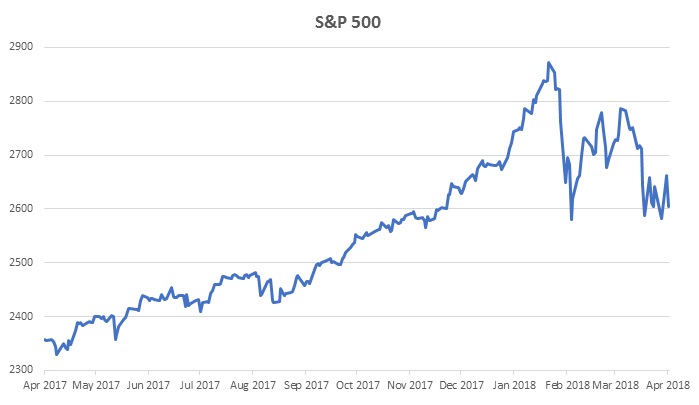
Hurricanes, fires, earthquakes, marches, market growth, a new tax plan and some unbelievable tweets – 2017 was an unforgettable year. Markets typically do not like uncertainty, but were strong through a year of swirling unpredictability. What happened and what comes next?
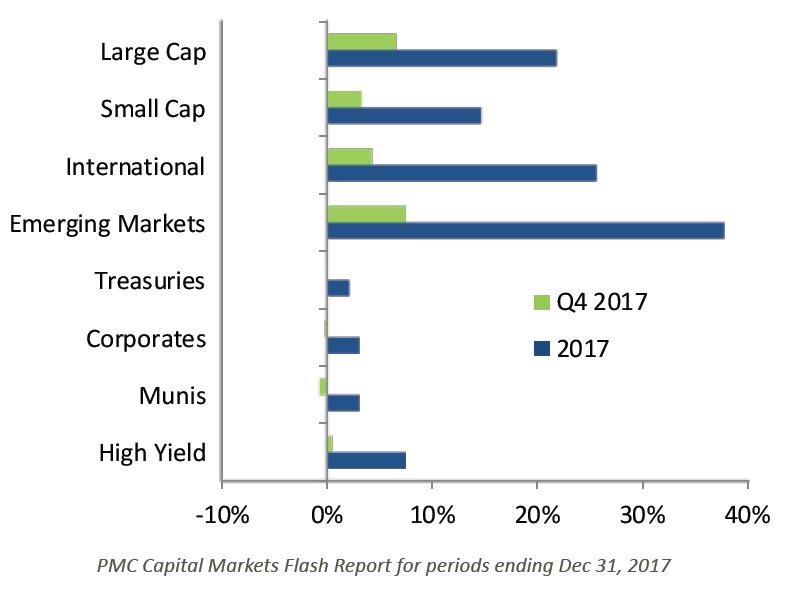
The S&P 500 (U.S. large cap) was up 6.6 percent in the quarter, bringing performance for the year to 21.8 percent. The Russell 2000 (small cap) was up 3.3 percent in the quarter, up 14.65 percent for the year. International stocks were up even more than domestic equities. The MSCI EAFE (developed international equities) were up 4.3 percent in the quarter, 25.6 percent for the year. Strongest of the major equity benchmarks was the MSCI Emerging Markets index, up 7.5 percent in the quarter and 37.8 percent for the year.

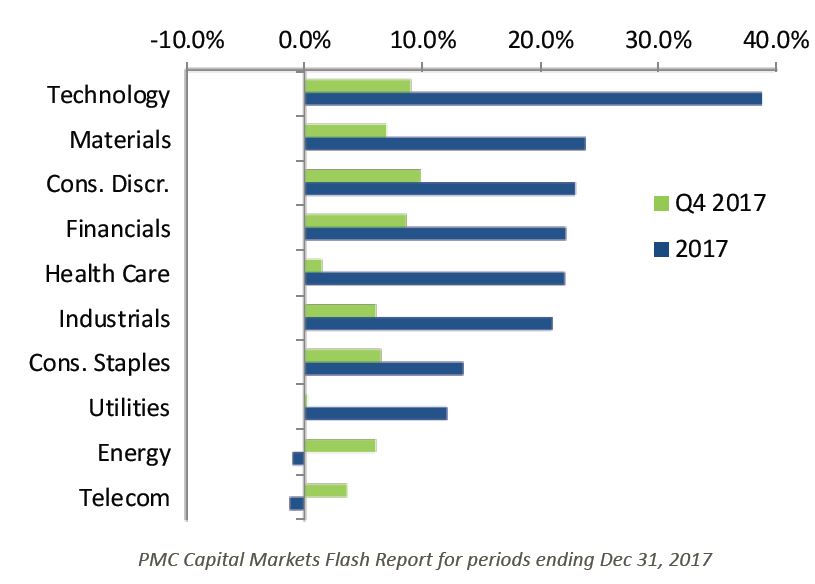
Within U.S. equity markets, the strongest performance came from the consumer discretionary sector, up almost 10 percent in the quarter, and 38.8 percent for the year. All sectors were positive in the quarter, led by technology, financials, materials, consumer staples, industrials, and energy stocks. However, even with strength in the last two quarters, energy and telecom remained negative for the year.

Investment-grade fixed income returns were challenged in the quarter by the second Fed Funds rate hike of the year in December. This was the first year since 2005 that the Fed raised interest rates twice. Intermediate corporate bonds were down 0.2 percent for the quarter but up 2.14 percent for the year. Municipal bonds ended the quarter down 0.7%, but were up 3% for the year. Treasuries were up 0.1% for the quarter, 2% for the year.
A tempered bond market is not a surprise with the rate hikes. And the rate hikes are not a surprise given the prolonged period of very low rates, near record expansion in the stock market, very low unemployment rates, and stable, sustained recovery in the economy. Less predictable is the impact significant corporate tax cuts will have on an already energized stock market and an economy that is eight years into expansion. Cuts to income taxes are likely to have a positive impact on both consumer spending and investments. Tabling for this discussion the potential positive economic impact of personal tax cuts and the regressive nature of the new tax plan, what impact might the corporate tax cuts have on the market and the economy? To understand this, we look at the stated intent of the corporate tax cuts, and how this may alter the current course of the economy.
The underlying premise of cuts to corporate tax rates has largely been the notion that reducing corporate tax rates will lead to greater investments by corporations. These investments will lead to job creation and wage growth. Perhaps corporations have been paying so much in taxes that they haven’t had enough money to invest in business expansions and wage increases. Business expansions stimulate the economy and can increase the number of jobs both in the short run (construction) and in the long run through new permanent jobs. In other words, more business spending could create more jobs, leading in turn to greater consumer spending and a robustly growing economy.
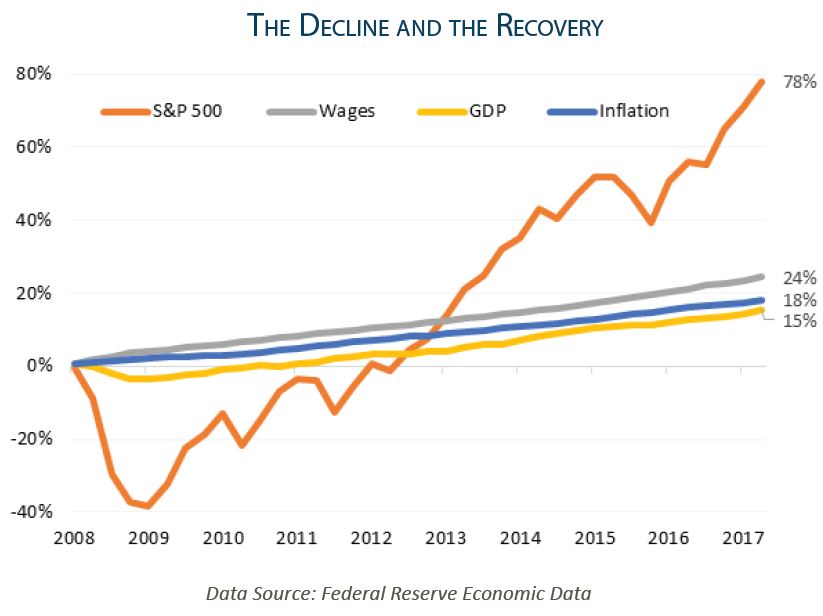
Contrasting the stock market’s growth since 2008 with that of the economy, we see two different declines, and two very different recoveries. While our GDP is up 15 percent and wages are up 24 percent from levels prior to the great recession, the S&P 500 is now 78 percent higher than it was before the market decline. In other words, this most recent expansion has favored shareholders over wage earners by a multiple of three.

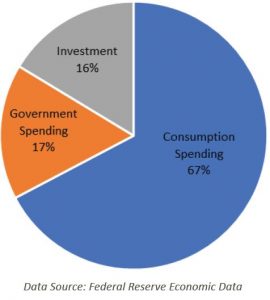
Growth of our economy is measured by the Gross Domestic Product (GDP), which breaks contributors into four broad categories: consumer spending, government spending, investment, and net exports which have been negative as we have imported more than we have exported for several decades. For as long as it has been measured, consumer spending has been the largest contributor to GDP, averaging about 67 percent and growing about 2.7 percent per year over the last twenty years. The next largest portion of GDP comes from government spending, which makes up about 19 percent of the GDP and has been growing at a rate of about 1.2 percent over the same time period. The smallest contributor to GDP over the last twenty years has been investment. Investment refers to business spending, primarily on equipment, buildings and land, and increases to inventories. In the last twenty years, this has averaged about 17 percent of the total GDP and has been growing at a rate of 2.8 percent. Finally, net imports detract an average of 3 percent from GDP and have been growing at about 4.5 percent per year.

Looking at the current economic recovery, the time since the recession ended in 2009 to now, something stands out. At 2.2 percent, growth in consumer spending has tracked below its longer-term average of 2.7 percent. Government spending has decreased by an average of 0.6 percent per year rather than its typical growth rate of 1.2 percent. The detraction of net exports on GDP is in line with its long-term average. While the U.S.’s negative net exports, which detract from GDP, are increasing, it makes up such a small portion of the total GDP that this higher growth rate has a low impact on total growth. Investment has been the outlier, growing 5.3 percent per year, almost double the long-term average of 2.8 percent. If growth in investments has already been much greater than the average rate and this hasn’t led to robust enough economic growth, why not?
The answer is that the high rate of investment spending has not yet led to growth in consumer spending. Despite adding 17.6 million jobs and taking unemployment from the peak in 2009 of 10 percent to the current low of 4.1 percent, consumers have been spending at a slower than normal rate. Because consumers buy the products made by corporate investments, corporations should only invest in increased lines of productions if they believe consumers want more of what they currently sell than they can currently produce. Trends since our last recession suggest that while corporate investment has more than recovered, the consumer has not. Without growing demand from strong consumers, corporations may continue to spend tax savings on higher dividends for shareholders or through share buybacks. Both will benefit shareholders more than consumers, or the broader economy.
The cut to corporate tax rates will most likely provide a nice boost to corporate earnings by inflating the year over year earnings growth rate, which may extend the bull market’s run. While the boost to earnings will continue for as long as the corporate tax cuts remain, the earnings growth rate will only be impacted for the first year. After that point, the stock market would need to find a new source for earnings expansion. There is little room for further reductions in unemployment, so growth in consumer spending would be easier to achieve from better paid workers rather than through increasing the number of workers. Higher wages could break the stagnation in consumer spending growth, and lend support to continuation of a strong stock market and strengthening economy.
Perhaps this is why Larry Fink, CEO of BlackRock, penned an impassioned letter to the CEOs of publicly traded companies. In his letter, Fink highlighted that in addition to financial analysis, a corporation’s strategic plans “must also understand the societal impact of your business as well as the ways that broad, structural trends – from slow wage growth to rising automation to climate change – affect your potential for growth.” He critiques CEO pressure to serve shareholders by distributing a higher portion of earnings at the expense of investments in future capabilities, such as employee development, fair wages, and innovation. “Companies must benefit all of their stakeholders, including shareholders, employees, customers, and the communities in which they operate.”
There is hope. In addition to thousands of bonuses announced after the tax plan passed, many of the largest employers, including Walmart and Starbucks, have announced increases to wages for their lowest paid workers. If we see a continuation of these types of increases, and additional increases bringing the lowest paid workers closer to a living wage, we could finally see a growth in consumer well-being and spending. Additionally, several companies have announced plans to add jobs in the US which could help the average annual jobs added number maintain or even exceed the annual rate of 2.2 million new jobs from the last eight years. Continuing job growth and increasing wages could provide a more stable base to our growing economy.
Key in the Veris investment philosophy is our belief that companies integrating environmental, social, and governance factors into their business practices are better positioned competitively and that the attention paid to these criteria can help mitigate risk. Reductions to government regulation of worker safety and environmental quality, along with wage stagnation that has coincided with a decline in union membership and clout, leaves both the environment and the economy in a precarious position. Both may be sustained by business practices that take a mindful approach, incorporating the societal impact of business into the business strategy, considering the long term rather than narrowly focusing just on the next quarter’s earnings.
While we grow investment strategies that meet our financial and impact criteria, we also are considering the ways in which changes to personal taxes impact both our clients and the investment strategies we deploy in your portfolio. With the magnitude of changes, many of our clients will benefit from a coordinated meeting between your wealth manager, tax planner, and estate planning attorney. If you have questions about how recent tax changes will affect you or your investments, we are here to start the discussion with you.
By Dave Kirkpatrick, SJF Ventures
Being a successful venture capitalist involves backing great entrepreneurs and helping them scale. Those activities are also important in fighting climate change.
Venture capital firms can identify and commercialize climate solutions that have an impact for the long term. That’s what my firm, SJF Ventures, has been committed to doing since 1999. We’re pleased others have joined us along this journey full of opportunity and risk.
In fact, many Silicon Valley VC funds eagerly entered the cleantech space several years ago, but stubbed their toe and exited the field. Most of these cleantech VC losses were concentrated in capital intensive companies developing solar modules and biofuels. These companies ran headlong into low-cost Asian solar manufacturers and dropping oil prices.
Yet all along the way, whether it be called ‘sustainable’ or ‘cleantech’ or ‘greentech,’ thoughtful investors have continued to place capital in companies providing climate solutions. These ventures have developed innovative business models utilizing IoT (Internet of Everything) tech, SaaS platforms, online marketplaces, and innovative chemistry and modular technology.
The Opportunities In Solar
A key focus of ours is investing in solutions that produce much higher levels of renewables, which can contribute to the resilience and reliability of the electric grid. These solutions are showing a path towards a carbon-free energy system through the combination of renewables, energy storage, smart grid, demand response, and electric transport.
We believe there is a significant opportunity in ‘downstream solar’ deployment firms that can deliver lower cost power at utility scale. For example, groSolar, an early national solar developer and installer, was one of our investments back in 2006. The company built 500 KW to 30 MW projects across the country and now leads the distributed energy division of EDF Renewable Energy. Community Energy (CEI), an early wind developer that has gone on to develop hundreds of megawatts of solar projects in many emerging solar states – NC, GA, VA, MN, CO, PA, NJ, MA, and IN – was one of our investments in 2010. CEI is responsible for the largest solar project in the Midwest, north of Minneapolis (pictured above), and in Virginia.
Through groSolar and Community Energy, we saw the potential to scale the delivery of low-cost power to states across the country with a mandate to increase renewable sources of energy, as well as utilities and corporate buyers.
In late 2014, we invested in NEXTracker, which had developed an elegant, low-cost, modular tracking system that greatly improves the power production on utility solar plants. NEXTracker went on to be acquired in late 2015 by Flex and has scaled deployment of clean power globally, with installations in Chile, Mexico, India, Australia, Jordan, as well as the US. The company has reached 9 GW of renewable energy capacity installed, including the largest North American project, a 750 MW installation in Mexico.
NEXTracker is a great example of the export opportunity for U.S. firms under the Paris Accord to assist developing countries for the low-carbon transition. Recent developments show countries like India, where NEXTracker has already sold 1 gigawatt of trackers. India has canceled plans for coal plants and is committed to scaling low cost renewable energy generation.
In October 2015, we wrote 100% Clean Energy – the new Zero Waste. Since then, many more companies have committed to 100% renewable power, including Facebook, IKEA, Apple, Walmart, Starbucks, UBS, Microsoft, Salesforce, HP, H&M, Goldman Sachs, and GM. Solar and wind are often the lowest cost power option, cheaper than new fossil fuel power. We have some threats to the US solar industry, such as the Suniva/Solar World trade dispute that may result in higher solar panel prices by later this year. Long-term, the continued trend should be towards lower cost, reliable power.
Clean power reliability will be strengthened by the recent drop in battery costs driven by electronics and electric vehicles. Low cost batteries are enabling large-scale solar, plus megawatt scale energy storage, to become competitive with peaking natural gas plants that switch online when energy demand peaks.
There is so much more to be done in combating climate change, but we’re making real progress. If we can align policy consistent with the Paris Accords along with visionary entrepreneurs and investors, we can and must accelerate that progress.
Dave Kirkpatrick is Co-Founder and Managing Director of SJF Ventures.
Photo Credit: Bureau of Land Management. Used under CC BY 2.0 license.
By Jane Swan, CFA, Senior Wealth Manager
Despite hurricanes, earthquakes, wildfires, and ongoing political chaos, markets climbed higher in the third quarter. The S&P 500 (U.S. large cap) was up 4.5 percent in the quarter, bringing year to date (YTD) growth to 14.2 percent. The Russell 2000 (small cap) was even stronger during the quarter, up 5.7 percent with YTD growth of 10.9 percent. If developed and emerging international markets hold their positions, they will be the best-performing risk asset classes for the first time in almost ten years. The MSCI EAFE (developed international equities) continued its rebound and was up 5.5 percent for the quarter and 20.5 percent for the year. Strongest of the major equity benchmarks was the MSCI Emerging Markets index, up 8 percent in the quarter and 28.1 percent for the year.

Within U.S. equity markets, the strongest performance came from the technology sector, up 8.7 percent in the quarter and 24.7 percent for the year. Market strength was also supported by advances in energy, telecom, materials, financials, and industrials. Health care, utilities and consumer discretionary sectors were also modestly positive in the quarter. Consumer staples was the only negative sector in the quarter. Despite strong growth in the quarter from energy and telecom, these are the only two sectors that are negative so far this year.
Fixed income returns remained positive, despite the two small interest rate hikes earlier in the year. US Treasuries were up 0.4 percent for the quarter and 1.6 percent for the year. Intermediate corporate bonds were up 0.6 percent for the quarter and 2.3 percent for the year. Intermediate municipals were up 0.7 percent for the quarter and 3.9 percent for the year. High-yield bonds, benefiting from continued economic expansion, were up 2 percent in the quarter bringing year to date return to 7 percent.
The run-up in high-yield bonds reflects further compression in the interest rate spread. The spread is the difference in yield paid on a Treasury bond and a high-yield (sometimes called “junk”) bond. Some view this spread as an indicator of future economic risk. If we anticipate continued economic strength, we do not recognize significant risk of default from even a low credit quality borrower. As a result, we are willing to buy the low-quality bond for just a small premium of additional income. If we believe the economy will be facing headwinds, we should require a higher increase in income when we buy a lower-quality bond. A contrary viewpoint suggests that investors can be overly influenced by stock market momentum. When markets are in long expansions, we seemingly forget that markets can go down. We forget to price in a premium for risky investments. It may take months or years to know if today’s narrow interest rate spreads were a sign of overly optimistic investors or an appropriate measure of a strong economy.
While bondholders may seem complacent, many equity investors are feeling uneasy about the possibility of a significant market downturn (“correction”). The length and magnitude of this expansion has many wondering how long this will last. Starting about four-and-a-half-years ago, news headlines have frequently celebrated each new market high. With each new record came the question, “How long will the market’s run last?” While we won’t know the answer until it actually ends, it is helpful to understand how this expansion relates to other market expansions.
Using the S&P 500 for reference and examining this market expansion in relation to prior market expansions, we see that the current bull market is one of the longest and strongest. However, it is not the longest nor is it the strongest. This expansion, having started in the beginning of March 2009, has lasted 103 months (8.6 years). That makes it the second-longest expansion. The longest expansion started in November 1990 and lasted until the dot-com bubble burst 118 months (9.8 years) later. To become the longest market expansion, our current growth would have to go for at least another 15 months.
Measuring the return of the expansion, we find a market gain of 243 percent from the prior low in 2009. There have been two greater market expansions in history. The greatest being that same expansion from the 1990s, when the market grew 399 percent. The second-greatest expansion was just after World War II. Beginning February of 1948, the market went up 246 percent in just over 8 years. To become the largest market expansion in history, our stock market would have to go up at least an additional 156 percent.
While the stock market has been growing significantly for a long time, these factors alone do not mean that an end is near.
There are several issues of greater concern than the length and magnitude of the expansion. A troubling aspect of this expansion is that it has left many behind. Real wage growth for non-supervisory workers dropped significantly in the 1980s and has not recovered. Suppressed wages hurt consumers’ ability to sustain growth in spending. The market has also seemingly shrugged off the increase in long-term potential risks from reduced regulations. These include reductions to environmental regulations and consumer protections, as well as regulations focused on preventing the kind of corporate risk-taking that led to the last economic decline. The market has been unphased by the inability of the branches of government to implement previously expected changes, such as building “the wall” or repealing the Affordable Care Act. It is unclear what, if any, portion of earnings forecasts or recent price appreciation is tied to optimism from financial analysts about possible tax cuts.
For most of the last four years of this market expansion, great speculation has focused on the next bubble to burst. Would it be commercial real estate? Gold? The dollar? Or something else? Regardless of when, why and by how much the market retreats, your Veris Wealth Advisor is here to partner with you in structuring a portfolio that incorporates your spending goals across a variety of market cycles.
By Casey Verbeck, Director, Business Development
As Veris marks our 10th anniversary we are optimistic. We’re emboldened by the fact that we launched in the worst global financial crisis since the Great Depression, and we succeeded because our clients’ demand for impact investing solutions is so strong and our team so committed.
We’re also optimistic because we see that impact investing and Veris are part of a much larger transformational ecosystem steadily gaining momentum. This ecosystem is advancing sustainability in business, investing, and society as a whole. It is pragmatically hopeful and touches most everything, large and small. It is self-organizing, ever expanding. It is guided by science, economics and spirit. Each part adds positive energy to this ever-expanding ecosystem. At work, at home.
This excerpt is from our recently published book celebrating the 10-year anniversary of Veris Wealth Partners. 10 Impacts In 10 Years is the story of our contributions to the world of impact investing and the heartening journey of our team. We created this reflection to recognize our clients and the collective progress we have made.
An Impactful Vision
In marking this milestone, it’s useful to start at the founding of our firm.
Ten years ago, the Veris founders – five entrepreneurs, including two impact investing advisory businesses – came together with an idea and a dream: To create a national Impact Private Wealth Management firm. The objective was to serve the growing needs of families, individuals and family foundations who want to go “all in” to create financial performance and impact with their wealth.
We felt a new day was emerging in which sustainable business and sustainable investing would integrate and change the way business operates and capital was invested. Ours was a vision in which sustainable businesses could change the world, and investors would choose to fund sustainable companies because they are the innovators and can deliver both financial performance and social benefit.
We believed, as did Generation Investment Management and others, that we were at a tipping point. No longer would Socially Responsible Investing be primarily about what companies shouldn’t do. Instead, sustainable and impact investing focused on what companies could do to create positive change, by understanding the drivers of great companies and transformative businesses.
We wanted to be part of this new ecosystem, aptly described by the United Nations, “Business as an Agent of World Benefit.” We also understood that many of the world’s most pressing challenges could not be addressed via business alone. That investing in NGOs and Community Banking was a critical part of building affordable housing, providing solar energy or clean drinking water in the villages of the world, and for empowering women through micro-finance.
A Vision Turns To Reality
With these dreams, plans, and thankfully a couple of hundred loyal clients, in August 2007 Veris opened our doors for business – just as the great financial crisis was beginning. There were 10 of us, and we managed about $350 million in assets, mostly on the East Coast. In the following decade, we developed and grew our San Francisco office, and more recently created a Boulder office. We are now 23 people. Amazingly, on June 13, the day of our 10th anniversary celebration at the Rubin Museum in New York, we hit $1 billion in assets under management.
We set out to be an independent firm, so we could stay completely focused on our clients, their needs and the kinds of impact investing they wanted across their entire portfolios. Importantly, we wanted to develop impact investments for all assets classes.
We also wanted to help steer our broader industry toward sustainable and impact investing. And we knew that if we stuck to our mission – if we didn’t mix up every type of investment style that might make excess returns – that Impact Investing would grow strongly.
We’ve done just that, and in the process, we have built dynamic partnerships in our industry. We have been joined by many new families and their foundations seeking impact private wealth management. They want to achieve this with a firm of like-minded professionals and fellow investors who share their passion for what’s possible.
A Year Of Celebrations
To celebrate and honor our clients, partners and employees, Veris has been holding celebrations and client learning meetings at each of our office locations. The first was in New York on June 13 at the Rubin Museum, and our second was in Portsmouth, New Hampshire on July 18. Our third will take place in San Francisco on September 26.
In Manhattan, 160 attended. We were very appreciative that many of our guests traveled for hours; many flew or came by train. The full-day event featured presentations from three of our Founders, Patricia Farrar-Rivas, Michael Lent and Steve Fahrer on “how we got here, what we have accomplished, and where we are going over the next decade.”
Lisa Woll, CEO of US SIF, the sustainable and impact investing trade association, provided an overview of the extraordinary growth of our industry over the last decade. From less than 10% of US assets managed for impact, to 25% and nearly $9 trillion today. One of the highlights of the day was a lengthy and weighty discussion with a multi-generational family who have worked with Michael for more than 20 years. The very reflective parents and their equally thoughtful Millennial children shared their common journey to impact investing, philanthropy and integrating their wealth into their lives. There were many damp eyes as people pondered how all these questions might play out in their families, or even if they could really have the conversation.
Also well received were our five client-led breakouts on our key thematic areas: Gender Lens Investing, Community Wealth Building, Sustainable Food & Agriculture, Climate Solutions, and Millennials. The passion shared in these intimate sessions were inspiring for us all.
I was personally thrilled to lead a conversation with Deval Patrick, Managing Director of Bain Capital’s new Double Impact Fund and the former Governor of Massachusetts. Deval was extremely articulate in explaining his shift from leading a state to building an impact investment fund at a very traditional private equity firm. He shared his hopes and his worries. And he reminded us change-makers “that too often we whisper our successes, while we shout out our failures.”
On July 18, we had another terrific event.
Nearly 100 clients, colleagues and friends came to the Veris Portsmouth 10th Celebration and Farewell Gathering for David Hills, a founding partner. It was a very special night supported by compelling remarks from keynoter Greg Watson, Director of Policy and System Design, E.F. Schumacher Center for a New Economics. Greg was formerly Secretary of Agriculture for Deval Patrick during his term as Governor of Massachusetts. Greg demonstrated that a lifetime of service in sustainable food and agriculture, both urban and rural, renewable energy, and creating more inclusive communities can be integrated for promising results.
Then, in a fireside chat, Veris partner Nicole Dolan discussed global and local sustainable business solutions for creating business as a force for change with Brad Sterl, founder and CEO, of Rustic Crust and Ken Locklin, Director, of Impax Asset Management. Rustic Crust is a New Hampshire company invested in by three Veris fund managers. Sterl provided a perspective on rural community job creation and sustainable food solutions. Impax sub-advises the Pax Global Environmental Market Fund and Locklin offered a global market perspective on energy efficiency, renewable energy and climate solutions. The audience was struck by the clarity that risk-taking and entrepreneurship drive real, positive change – be that in global solar projects or baking the best organic pizza dough in the U.S. from a rural New Hampshire town.
Perhaps the most poignant part of the evening was partner Alison Pyott’s farewell to David Hills, a founding Veris partner who has recently retired from the firm. In a heartfelt tribute, Alison and David recounted their collaboration, dilemmas and joys over the past decade working together and with clients. David shared some of his pioneering efforts over his 30-year career in impact investing and the depth of friendships he created. They made a bet who would tear up first. David lost.
Looking Ahead
In closing, I wanted to share the following excerpt is from our 10th anniversary book. It sums up how the team at Veris feels about the future.
To our clients, employees, colleagues and friends: Thank you for your support over the years. We depend on the depth of your wisdom to do our work better. And to learn together.
We are optimistic as we head into the next decade, despite significant challenges.
We’re hopeful because a new generation of investors and business leaders actively believe and demonstrate that sustainability and impact investing works! We are finally approaching the tipping point where this new generation sees the management power of sustainability. They understand that Sustainability = Innovation.
We are also hopeful because of the unstoppable tide of impact in business-driven innovation. These companies invest in people, communities, creativity, and transformative technologies.
We know some don’t chare our optimism. We know the enormous challenges in front of us could thwart us. However, the wind in now at our back. Just 10 years ago, it was blowing against us.
Philadelphia
100 S Juniper St., 3rd Floor, #410
Philadelphia, PA 19109