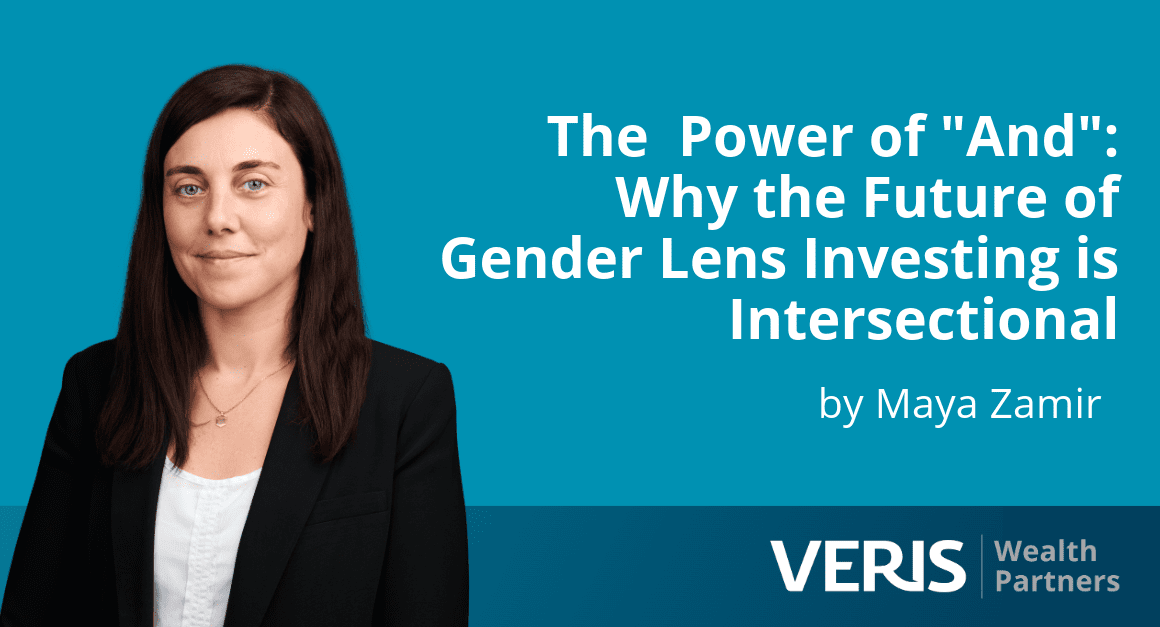
The Power of “And”: Why the Future of Gender Lens Investing is Intersectional
By Maya Zamir
In early February 2025, one month after returning from maternity leave, I joined Convergence XXI, a month-long global convening led by Criterion Institute dedicated to envisioning the next era of gender lens investing.¹ Practitioners from around the world, each of us bringing different experiences and perspectives on gender lens, met bi-weekly to discuss the state of the field and share our ideas about what might come next. Through these sessions we explored five possible “futures,” each representing a different way finance could advance gender equity.
Returning from maternity leave, conversations about equity, care, and systems resonated. And yet, deciding which future felt most aligned with my perspective proved surprisingly difficult. Throughout the month, I found myself reflecting on the tension between ambition and practicality, and how visionary change might take shape within the current US political and economic context.
The five futures presented a spectrum of possibilities for this work, from one where gender considerations become fully integrated across all sustainable finance to another where deep, niche, and locally grounded funds lead innovation through bold, context-specific approaches. Some futures envisioned universal standards and shared metrics that could bring scale and credibility, while others emphasized shifting power toward regional ecosystems and locally led capital strategies. The last vision imagined gender lens investing evolving into a movement for systemic change – one that redefines how capital flows, who holds power, and what kinds of value finance is designed to create.
What future would you choose?
The Power of “And”: Focusing on Intersectionality
Each future captured something essential about how this field has evolved and what it could become. But as the month progressed, and as Criterion’s 2025 Reimagining Gender Lens Investing Futures report² later articulated so well, I realized that we don’t need to choose. I believe the strength of this movement lies in its plurality, in the coexistence of mainstream and niche, global and local, pragmatic and even radical.
As Criterion notes, “the field of gender lens investing is not monolithic, and that is our strength…Embracing this diversity doesn’t mean agreeing on everything; it means recognizing that progress looks different in different contexts, and that complexity is not a problem to solve but a reality of systems change. Tensions need to be held with honesty, care, and creativity. The field’s future depends not on choosing one path or answer, but on building the relationships, structures, and imagination to hold them all.”
Veris is a majority women-owned and -led pioneer in gender lens investing with our first white paper on gender lens investing launched in 2012. (Explore our history in the development of the field in Veris 2018 report Gender Lens Investing: Building the Arc of Finance for Women and Girls). Over a decade later, we continue to work with fund managers focused specifically on gender diversity and equity, and many of these are funds highlighted in reports by organizations like Parallelle Finance.³ Alongside that, and without discounting the need for deep and niche, intersectionality has become central to how Veris approaches gender lens investing, connecting gender equity with other systemic priorities such as racial justice, climate resilience, and community wealth building.
Coined by Kimberlé Crenshaw, intersectionality highlights how overlapping systems of oppression, including gender, race, and class, compound disadvantages. For investors, this means seeking opportunities where one investment can address interconnected challenges and drive multiple impact outcomes simultaneously.⁴
Especially in a moment when conversations about equity are being contested, intersectionality seemingly offers a practical way to bridge priorities and mobilize broader coalitions of investors, including those whose entry point may not be gender, but who seek solutions in climate, health, or economic resilience. As such, funds might unlock greater pools of capital by aligning gender and racial equity with themes such as climate adaptation or regenerative agriculture. For example, an investor primarily focused on climate mitigation may be more inclined to invest in a strategy that also embeds strong gender equity practices. I believe this ability to deliver on multiple goals through a single investment will not only attract diverse capital sources but also help bend large, thematic flows of capital toward systemic change.
Intersectionality in Practice
At Veris, gender lens investing has long been a core thematic focus. But like the field itself, our approach has evolved. What began as a separate theme now sits within a broader thematic focus on Racial and Gender Equity, reflecting our belief that these issues are deeply intertwined. There are now hundreds of fund managers incorporating gender equity into their investment theses and commitments, including initiatives such as the 2X Challenge.⁵ We have the privilege of working with fund managers addressing the intersection of our focus themes. Below are a few examples that embody this intersectional approach, illustrating how gender lens investing can expand its reach and relevance.
Gender + Climate: Building Equitable Energy Transitions
Streetlife Ventures,⁶ led by two women general partners, invests in early-stage companies developing innovative urban climate solutions across North America and Europe. The fund focuses on pre-seed and seed-stage B2B startups operating at the intersection of cities and climate, in sectors such as buildings, energy, mobility, waste, and climate adaptation. Through this focus, Streetlife Ventures aims to accelerate the transition toward more sustainable and resilient urban environments. One of the elements that further differentiates Streetlife Ventures is its intentional commitment to diversity. As part of the New York City Economic Development Corporation’s Venture Access Alliance, the fund actively supports underrepresented founders. It also built and operates a Climate Tech Cities Network of more than 25,000 members, which has achieved gender parity, and partners with organizations like Amazon and NYU to spotlight women and diverse entrepreneurs through its quarterly Climate Tech Demo Nights. The goal is advancing climate innovation that reflects the diversity of the communities it aims to serve.
Sunwealth Solar Justice Fund⁷ takes this commitment in a different direction within the renewable energy sector. A mission-driven developer, owner, and operator of small-scale solar projects, Sunwealth expands equitable access to clean energy in underserved American communities. By providing much needed development capital to diverse-led solar developers, such as Sol Source Power, ⁸ a women-led firm serving low- and moderate-income (LMI) communities, Sunwealth aims to advance positive environmental impact while ensuring inclusive participation within the energy transition, both from a beneficiary and the developer standpoints.⁹
Gender + Sustainable Agriculture: Financing Rural Resilience
Root Capital¹⁰ provides credit and capacity building to small agricultural businesses and cooperatives in rural communities in Latin America, Africa and Indonesia. Through its Women in Agriculture Initiative (WAI), launched in 2012, Root Capital has supported thousands of women with access to finance, leadership training, and peer networks.¹¹ Today, Root Capital’s approach integrates multiple lenses – gender equity, youth inclusion, and climate adaptation – to empower rural enterprises holistically. By supporting enterprises to develop gender action plans, offering gender equity grants, and promoting regenerative agricultural practices, Root Capital demonstrates how capital can foster resilience and justice in communities most vulnerable to climate and economic shocks.
Gender + Health Equity: Investing in Women’s Health
Foreground Capital ¹² invests in early-stage companies aiming to advance innovation in women’s health – from conditions that uniquely affect women, to diseases that disproportionately impact them, to those that manifest differently by gender. Foreground applies a gender-informed lens not only to products and solutions but also to affordability and accessibility.¹³ By backing companies that improve health outcomes and economic participation for women, the fund aims to help close the gender health gap. In a healthcare landscape historically underfunded for women’s needs, Foreground addresses gender inequality while creating broader societal and economic value.
Gender + Community Wealth: Intersectionality in Practice through Community Loan Funds
Many community development financial institutions (CDFIs) and community loan funds naturally embody an intersectional approach to their lending. Whether their primary focus is on quality jobs, affordable housing, access to education, health, or economic mobility, considerations of gender and race are inherently woven into their strategies and decision-making processes due to their focus on underserved and under-resourced communities.
Community loan funds understand that financial inclusion and community development cannot be achieved in isolation. We believe equity across gender and race is central to achieving sustainable impact. We see this consistently across the community loan funds we work with at Veris, including Calvert Impact Capital,¹⁴ Oweesta Corporation, Coastal Enterprises Inc. (CEI), and Seed Commons, all of which demonstrate how targeted, place-based lending can advance both social equity and economic resilience.
As illustrated in the examples above, intersectional investing creates value across themes, opening new capital pathways for fund managers, offering investors diversified impact exposure across themes, and delivering solutions that reflect real-world complexity for communities.
Beyond Themes: Toward Systems Change
The Criterion Institute’s “futures” remind us that gender lens investing is not a destination, but a process, one that depends on experimentation, collaboration, and a willingness to see across systems. At Veris, we see this reflected in our clients’ growing interest in multi-issue investing, aligning portfolios not just with values, but with interconnected systems of change.
Gender lens investing has come a long way from its early days as a niche concept that needed to be proven. Today, we believe the question is less about whether investors should apply a gender lens, and more about how we can make that lens broader, bolder, and more intersectional.
Returning to the original question we were asked during our Convergence immersion – What future will you choose? – my answer is that we can each pick our own visions of the future, and we don’t need to limit ourselves to just one. The future of gender lens investing depends less on choosing a single path, and more on how we connect them: through intersectionality, collaboration, and shared purpose.
Author
Maya Zamir is Associate Director, Investments at Veris. She is responsible for sourcing, due diligence and monitoring of investments across asset classes, oversees impact measurement and management and contributes to thematic research. Prior to joining Veris, Maya completed her MBA from Columbia Business School and gained impact investing experience through internships with The Rockefeller Foundation, Bridges Fund Management Israel, and TomorrowNow.org. Maya also previously served as a corporate lawyer at FBC & Co., specializing in renewable energy and infrastructure, and finance and banking. Read Maya’s Full Bio.
Note: A version of Maya Zamir’s article was previously published by AdvisorPedia under the title: From Futures to Intersections: Expanding on Gender Lens Investing
Sources
1. https://www.criterioninstitute.org/events/convergence-xxi-february-2025
2. https://www.criterioninstitute.org/resources/reimagining-gender-lens-investing-futures
3. https://parallellefinance.com/gender-lens-investing-review/; https://parallellefinance.com/wp-content/uploads/2025/05/GLI2025-Full_090525.pdf
4. https://chicagounbound.uchicago.edu/cgi/viewcontent.cgi?article=1052&context=uclf
5. https://www.2xchallenge.org/
6. https://www.streetlifeventures.com/
7. https://www.sunwealth.com/how-we-invest
8. https://solsourcepower.com/
9.https://static1.squarespace.com/static/59552faaff7c50fb8b38c931/t/67be8e2ad789dd5af95bd2d8/1740541487542/Sunwealth+2024+Impact+Report.pdf
10. https://rootcapital.org/
11. https://rootcapital.org/our-approach/womens-empowerment/
12. https://foreground.vc/
13. https://foreground.vc/about/
14.https://assets.ctfassets.net/4oaw9man1yeu/2X1gLdNUrUPFhRAJbAXp1q/205876bdd2d7e076fce05d5771183dfe/calvert-impact-capital-gender-report.pdf
Disclaimer
The information contained herein is provided for informational purposes only and should not be construed as the provision of personalized investment advice, or an offer to sell or the solicitation of any offer to buy any securities. Rather, the contents including, without limitation, any forecasts and projections, simply reflect the opinions and views of the authors. All expressions of opinion reflect the judgment of the authors as of the date of publication and are subject to change without notice. There is no guarantee that the views and opinions expressed herein will come to pass. Additionally, this document contains information derived from third party sources. Although we believe these third-party sources to be reliable, we make no representations as to the accuracy or completeness of any information derived from such third-party sources and take no responsibility, therefore. This document also contains certain sample information about various funds. No inference should be drawn regarding the success of such funds or that they are indicative of other similarly-situated funds in terms of their financial performance or impact.